
Why Small Businesses Struggle with Instagram Growth
Instagram organic growth for small businesses is defined by a fundamental mismatch: the platform's algorithm rewards behavior that most small business owners don't have the time, tools, or training to deliver consistently. Average engagement rates for business accounts range from 0.50% to 12% depending on industry and account size. That spread is enormous, and most small businesses land at the low end. Understanding why small businesses struggle with Instagram growth starts with recognizing that the platform has changed faster than most owners' strategies have.
Why do small businesses struggle with Instagram growth?
The Instagram algorithm in 2026 does not distribute content equally. It rewards accounts that generate strong engagement signals quickly after posting. If your post collects a handful of likes in the first hour, the algorithm reads that as low interest and limits how many more people see it. This creates a compounding problem for small businesses with small existing audiences.
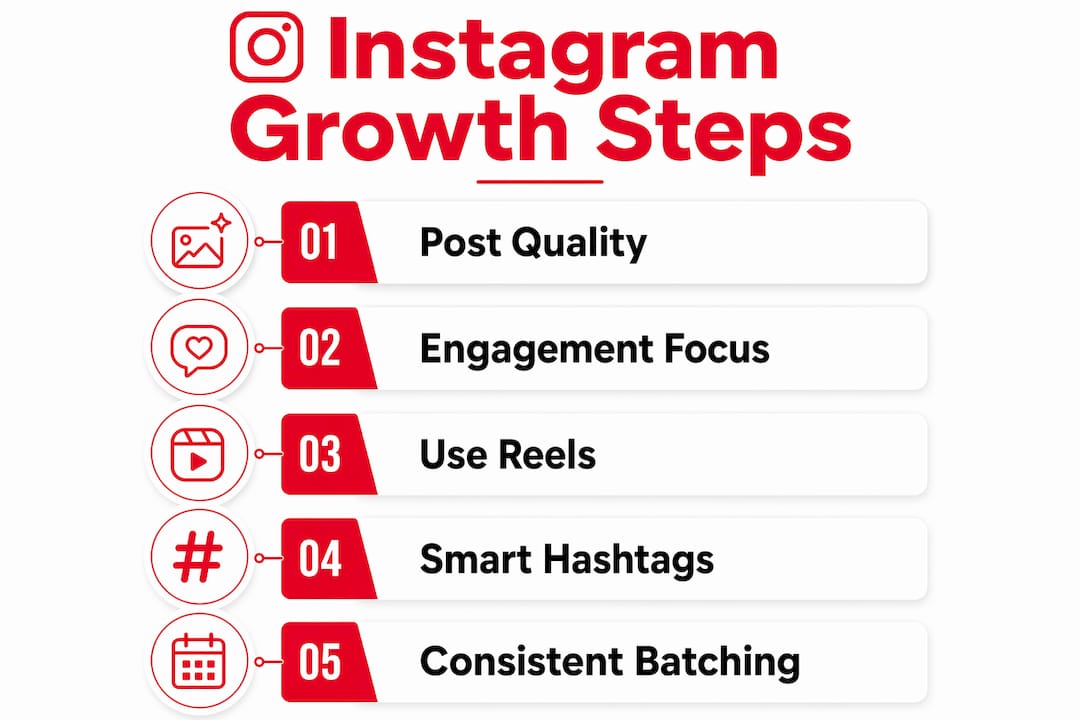
Reels are the primary discovery engine on Instagram in 2026, outperforming static posts for reaching new audiences. That means if you are only posting photos or carousels, you are essentially invisible to anyone who does not already follow you. Discovery, the process of reaching people who have never heard of your business, now runs almost entirely through short-form video.
The signals that actually move the algorithm are not the ones most owners focus on. The algorithm treats saves and shares as far stronger signals than likes. A save tells Instagram your content is worth returning to. A share, especially through a direct message, acts as a peer endorsement. Likes, by contrast, carry minimal algorithmic weight in 2026.
Hashtag strategy has also shifted. Using 3–5 relevant hashtags now outperforms the old practice of stacking 20–30 tags per post. Hashtag spamming no longer drives growth and may actually reduce distribution. The algorithm reads it as low-quality signaling.
Pro Tip: Test your content by asking yourself: "Would someone save this or send it to a friend?" If the answer is no, rework the concept before posting.
Common operational mistakes that stall Instagram growth
Most small business owners treat Instagram as a daily reactive task. They open the app, feel pressure to post something, and publish content that was created in minutes with no clear purpose. This approach produces inconsistent quality and inconsistent posting patterns, both of which the algorithm penalizes.
- Posting without a content system. Winging content daily leads to burnout within weeks. Without a repeatable process, posting frequency drops, and the algorithm deprioritizes accounts that go quiet.
- Avoiding Reels entirely. Many owners skip video because it feels complex or time-consuming. The result is a feed-only strategy that reaches only existing followers and generates almost no new discovery.
- Buying followers or engagement. Fake followers lower engagement metrics, which causes Instagram to limit how widely your content is distributed. Buying followers does not just waste money. It actively shrinks your real reach.
- Ignoring community engagement. Posting and disappearing is a growth killer. Responding to comments, replying to DMs, and engaging with other accounts in your niche all send positive signals to the algorithm.
- Chasing likes over saves. Designing content for likes rather than saves or shares means optimizing for the wrong metric entirely.
Posting 3–5 high-quality posts per week consistently outperforms daily posting with mediocre content. Quality and regularity together build the trust signals the algorithm needs to expand your reach.
Pro Tip: Block two hours every other week to batch-create your content. Shoot multiple Reels in one session, write captions in bulk, and schedule everything. You will post more consistently and feel less drained.
Does your business type affect Instagram growth potential?
Instagram does not work equally well for every business. The platform favors visual, impulse-driven purchases. A boutique clothing store, a bakery, or a fitness studio can show products and results in a single image or short video. The viewer sees something appealing and acts quickly.
Instagram works best for visual, B2C businesses with impulse purchase behavior. Retail, hospitality, and lifestyle brands thrive here. Long sales cycle B2B companies and high-urgency service businesses, like plumbers or accountants, see little organic conversion from Instagram alone.
| Business type | Instagram growth potential | Better alternative |
|---|---|---|
| Retail and e-commerce | High | Instagram is the right fit |
| Hospitality and food | High | Instagram is the right fit |
| Fitness and wellness | High | Instagram is the right fit |
| B2B professional services | Low | LinkedIn drives better results |
| High-urgency local services | Low | Google Search and Maps convert faster |
| Local brick-and-mortar | Moderate | Pair Instagram with Google Business Profile |
Geographic specificity matters for local businesses. A restaurant in Austin posting generic food content competes globally. A restaurant posting content tied to Austin neighborhoods, local events, and community stories reaches a more relevant audience. Local content signals help the algorithm surface your posts to nearby users.
Instagram is not a universal platform. Some business types derive little benefit and should consider alternative channels. Recognizing this early saves months of wasted effort.
What strategies actually work for small business Instagram growth?
The businesses that grow consistently on Instagram in 2026 share one trait: they treat content creation as a system, not a spontaneous act. Here is what that looks like in practice.
- Batch your content creation. Batching content once every two weeks sustains output past the six-week dropout point where most small business owners quit. Shoot several Reels in one session, write all your captions at once, and schedule them in advance.
- Lead with low-lift Reels. You do not need professional video production. A 15-second clip showing your product being made, a before-and-after result, or a quick tip filmed on a phone performs well. Authenticity outperforms polish on Instagram.
- Design for saves and shares. Create content that teaches something, solves a problem, or surprises the viewer. Checklists, how-to sequences, and "did you know" formats consistently earn saves.
- Optimize your profile for Instagram SEO. Use your primary keyword in your name field and bio. Instagram's search function indexes these fields, which means a well-written bio helps new users find you organically.
- Use Stories for nurturing, Reels for discovery. Stories keep existing followers engaged and warm. Reels reach new audiences. Both serve different purposes and should be part of your weekly content mix.
- Engage before and after posting. Spend 10–15 minutes engaging with accounts in your niche before you post. Reply to every comment within the first hour after publishing. Early engagement signals tell the algorithm your content is worth distributing further.
The flywheel works like this: real engagement earns more reach, which brings in more real followers, who generate more engagement. Shifting focus from vanity metrics to meaningful engagement is what separates accounts that plateau from accounts that grow.
Key Takeaways
Small businesses fail on Instagram primarily because their content strategy does not align with how the algorithm distributes content in 2026, particularly the shift to Reels and engagement signals like saves and shares.
| Point | Details |
|---|---|
| Algorithm favors Reels | Static posts reach only existing followers; Reels drive new audience discovery. |
| Saves and shares matter most | Design content that teaches or surprises to earn the signals that expand reach. |
| Batch content to stay consistent | Creating content every two weeks prevents burnout and maintains posting regularity. |
| Business type determines fit | Visual B2C businesses grow faster; B2B and high-urgency services should consider other platforms. |
| Buying followers backfires | Fake followers lower engagement rates and cause Instagram to limit your real reach. |
The uncomfortable truth about Instagram growth for small businesses
I have watched hundreds of small business owners pour time into Instagram and walk away frustrated. The pattern is almost always the same. They post consistently for four or five weeks, see little traction, and either give up or start chasing shortcuts like buying followers. Both responses make the problem worse.
The real issue is not effort. It is misaligned effort. Posting daily without a content system is exhausting and ineffective. Chasing likes instead of saves means optimizing for a metric the algorithm barely registers. And skipping Reels because they feel complicated means opting out of the only format that reliably reaches new people.
What actually works is treating Instagram like a business process, not a creative outlet. That means batching, scheduling, tracking the right metrics, and making decisions based on what the data tells you. A fitness coach who goes from 2,000 to 18,000 followers does not get there by posting more. They get there by posting smarter, focusing on saves and shares, and building a content rhythm they can sustain.
The hardest shift for most small business owners is accepting that Instagram growth is slow and compounding. The first 90 days rarely look impressive. But accounts that stay consistent and focus on real engagement signals build momentum that accelerates over time. The flywheel is the whole point.
— Zen
How Sogrow helps small businesses grow on Instagram
Small business owners do not fail on Instagram because they lack creativity. They fail because they lack a system that works with the algorithm, not against it.
Sogrow is built specifically for this problem. Its AI-powered approach identifies the content signals and posting patterns that drive real follower growth, so you are not guessing what works. Sogrow focuses on attracting genuine followers who actually engage with your content, not inflated numbers that tank your reach. Clients have grown from 2,000 to 18,000 followers and tripled their engagement rates within weeks. If you are ready to build an Instagram presence that generates real business results, start with Sogrow and put a real system behind your growth.
FAQ
Why is my Instagram not growing even when I post regularly?
Posting frequency alone does not drive growth. The algorithm prioritizes engagement quality, particularly saves and shares, over posting volume. Consistent, save-worthy content outperforms frequent, low-engagement posts.
Do hashtags still help small businesses on Instagram?
Using 3–5 relevant hashtags per post aligns with current algorithm behavior. Stacking 20–30 hashtags no longer drives reach and may reduce distribution.
Should every small business invest time in Instagram?
No. Instagram works best for visual, B2C businesses with impulse purchase behavior. B2B companies and high-urgency service providers typically see better results on LinkedIn or Google Search.
What type of content gets the most reach on Instagram in 2026?
Reels are the primary discovery format on Instagram in 2026. Short, authentic video content consistently outperforms static posts for reaching new audiences outside your existing followers.
Does buying followers hurt your Instagram account?
Buying followers actively damages your account. Fake followers lower your engagement rate, which signals to Instagram that your content is low quality, causing the algorithm to limit your real reach.