
Why Real Followers Matter for Brands on Instagram
Real followers are the single most important asset a brand can build on Instagram, directly determining whether content reaches new audiences, generates revenue, or disappears into the feed. Authentic follower engagement, the industry term for genuine interaction from real people, separates brands that grow from brands that stagnate. Follower count alone tells you nothing about whether your audience will buy, share, or trust you. Understanding why real followers matter for brands means understanding how Instagram's algorithm, consumer psychology, and marketing ROI all point to the same conclusion: quality beats quantity, every time.
Why real followers matter for brands on Instagram's algorithm
Instagram's 2026 algorithm does not reward popularity. It rewards relevance, and relevance is measured through engagement depth. Shares, saves, and comments are the ranking signals Instagram prioritizes, with content shared via direct messages carrying the highest weight of all. This matters because only real followers generate those signals. Bots do not save posts. Inactive accounts do not share Reels with friends.
When a real follower shares your post to their DMs, Instagram reads that as a strong signal that your content is worth distributing beyond your existing audience. That single action can push a post into Explore, Reels recommendations, or suggested accounts. A fake follower produces none of this. It sits on your profile like dead weight, diluting your engagement rate and suppressing your organic reach.

The practical implication is direct. A brand with 10,000 real followers who regularly save and share content will consistently outperform a brand with 100,000 followers where 60% are bots or ghost accounts. Instagram's distribution engine is built to detect and reward genuine interaction, which means every fake follower you accumulate actively works against your visibility.
Pro Tip: Track your "shares per post" metric in Instagram Insights. If that number is consistently low relative to your reach, your audience may not be as engaged or authentic as your follower count suggests.
The signals Instagram values most from real followers include:
- Saves: Indicate the content is worth returning to, signaling high perceived value.
- DM shares: The strongest distribution signal, showing the content resonated enough to share privately.
- Substantive comments: Multi-word, on-topic responses that indicate genuine attention.
- Profile visits after a post: Show that the content created curiosity about the brand itself.
Does follower quality matter more than follower quantity?
The answer is unambiguous: follower quality drives revenue, follower quantity drives ego. Engagement behaviors like saves, comments, and DMs correlate directly with downstream actions including clicks, purchases, and word-of-mouth referrals. A brand with 5,000 highly engaged followers has a more monetizable audience than one with 500,000 passive ones.
Consider a fitness coach who grows from 2,000 to 18,000 followers using Sogrow's AI-driven approach, with engagement tripling in the process. That growth is not just a vanity number. It represents 16,000 additional real people who are interested in fitness content, likely to click on product links, and willing to share posts with their own networks. That is a revenue channel. A purchased audience of 50,000 bots is not.
"The right followers are not just numbers. They are potential customers, brand advocates, and community members who amplify your message without you paying for every impression."
High follower counts with low engagement are a vanity metric. Marketers who report follower growth without engagement data are measuring the wrong thing. Authentic audiences signal higher revenue potential because they represent real people with real purchasing power who have voluntarily opted into your brand's world.
There is also a community momentum effect that brands underestimate. When real followers comment, share, and engage, they create social proof that attracts more real followers. New visitors see active conversations and interpret that as a signal that the brand is worth following. Fake followers produce the opposite effect. A profile with 80,000 followers and 12 comments per post raises immediate suspicion among savvy consumers and potential brand partners.
What are the real risks of fake or inactive followers?
Fake followers do not just fail to help. They actively damage your brand in measurable ways. Fake followers distort analytics, lower engagement rates, and waste ad spend, making it nearly impossible to accurately measure what content actually works. When your performance data is polluted by fraudulent accounts, you end up optimizing for the wrong signals.
The financial cost is significant. Brands lose up to 15% of influencer marketing budgets to fraudulent engagement, according to research cited by InfluenceFlow. That is not a rounding error. For a brand spending $100,000 annually on influencer campaigns, $15,000 is going directly to waste because the audience being reached does not exist in any meaningful sense.
The risks compound beyond budget waste:
- Suppressed organic reach: Instagram detects inauthentic engagement patterns and reduces content distribution for accounts flagged as having inflated audiences.
- Damaged brand credibility: Consumers, journalists, and potential partners increasingly audit follower quality. Getting caught with a fake audience destroys trust faster than almost any other mistake.
- Misleading creative decisions: Fake follower inflation causes misinterpretation of content performance, leading brands to double down on content strategies that are not actually resonating with real people.
- Platform penalties: Meta has escalated enforcement against inauthentic behavior. Meta's legal action against scam advertisers in 2026 signals that the platform is actively hostile to fraudulent audience tactics, not just passively filtering them.
How do brands evaluate follower authenticity and engagement quality?
Smart brands and agencies have moved beyond follower count as a selection criterion. The new standard is audience authenticity, evaluated through a combination of qualitative and quantitative signals. Trust signals like comment quality, purchase intent language, and consistent engagement outperform follower count in predicting campaign ROI.
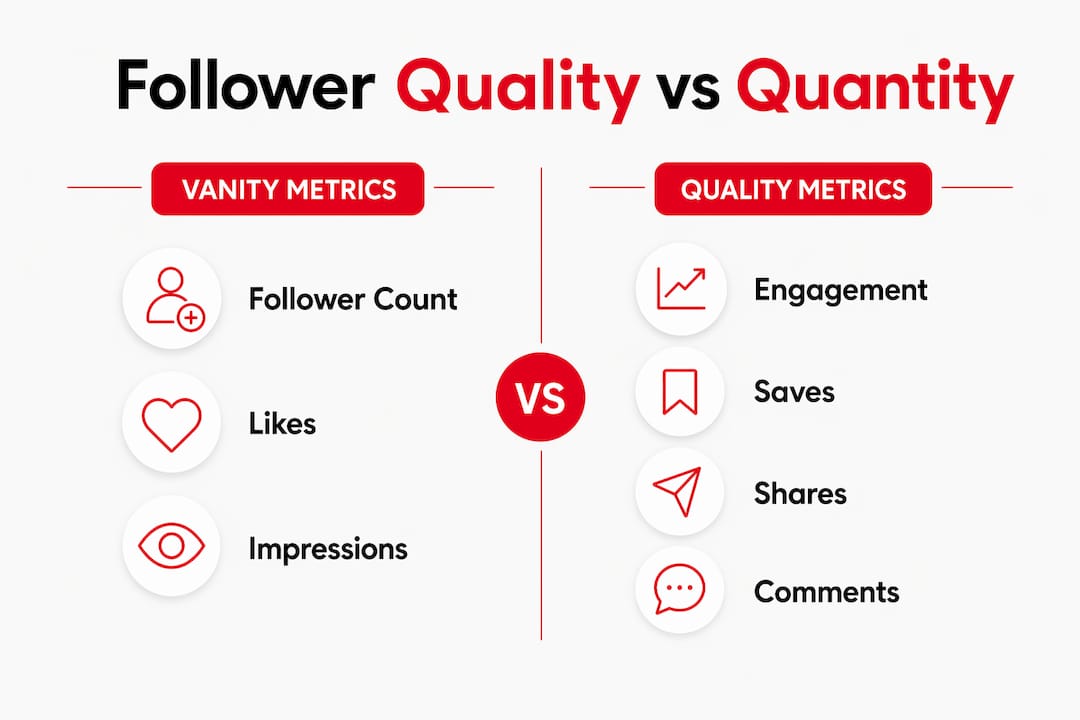
The most sophisticated brands now use weighted trust scorecards when evaluating creators or auditing their own audiences. These scorecards factor in engagement authenticity, comment sentiment, and purchase intent proxies, then filter out accounts that fall below thresholds regardless of follower size. A creator with 30,000 followers and a trust score in the top quartile will outperform a creator with 300,000 followers and a mediocre score.
Here is how the two evaluation approaches compare:
| Metric | Vanity approach | Quality approach |
|---|---|---|
| Primary signal | Total follower count | Engagement rate + comment depth |
| Engagement measure | Total likes | Saves, shares, and substantive comments |
| Audience check | None | Follower authenticity audit |
| ROI predictor | Reach potential | Cost-per-trusted-impression (CPTI) |
| Campaign outcome | Impressions | Conversions and purchase intent |
Cost-per-trusted-impression (CPTI) is the metric replacing CPM for brands serious about ROI. It calculates the cost of reaching one genuinely engaged, real person rather than one account in a database. Follower count functions as a minimum reach threshold, not a quality indicator, which means brands should set a floor for reach and then select based on trust signals above that floor.
Pro Tip: When auditing an Instagram account, look at the ratio of comments to likes. Authentic accounts typically see 1 comment for every 10 to 30 likes. A ratio far below that, especially on accounts with large followings, is a reliable indicator of fake or disengaged audiences.
Authentic followers also provide something no paid research can replicate. Engaged audiences deliver free market research, surfacing product feedback, unmet needs, and content preferences through their natural interactions. Brands that listen to their real followers gain a competitive intelligence advantage that brands chasing vanity metrics never access.
How can brands attract and build real followers on Instagram?
Building an authentic Instagram audience is not a hack. It is a system. Brands that grow genuine communities follow a repeatable process centered on relevance, consistency, and content designed for deep interaction rather than passive scrolling.
Define a clear niche and stick to it. Audiences follow accounts that stand for something specific. A fitness brand that posts workout tips, nutrition advice, and recovery content attracts followers who care about all three. Diluting your content with off-topic posts confuses the algorithm and your audience simultaneously.
Create content built for saves and shares. Carousels with step-by-step frameworks, Reels that solve a specific problem, and infographics that people want to reference later all generate the save and share signals that Instagram rewards. Content that sparks genuine interactions in your niche is consistently favored by Instagram's distribution system.
Engage actively, not passively. Reply to every comment in the first hour after posting. Respond to DMs. Ask questions in captions that invite real responses. The algorithm treats your own engagement behavior as a signal of account quality.
Collaborate with creators who have authentic audiences. Partnering with a micro-influencer who has 15,000 real, engaged followers in your niche will outperform a macro-influencer with 500,000 followers and a suspicious engagement rate. Building authentic communities requires consistent engagement and collaborative efforts centered on relationships, not reach.
Never buy followers or use engagement pods. The short-term vanity boost is not worth the long-term algorithmic penalty, the credibility damage, or the wasted budget. Every purchased follower is a liability, not an asset.
Key takeaways
Authentic followers are the foundation of every measurable Instagram outcome, from algorithmic reach to conversion rates and brand credibility.
| Point | Details |
|---|---|
| Algorithm rewards real engagement | Saves, DM shares, and substantive comments from real followers drive Instagram's content distribution. |
| Quality beats quantity | A small, engaged audience generates more revenue and trust than a large, inactive one. |
| Fake followers cost real money | Brands lose up to 15% of influencer budgets to fraudulent engagement, plus face organic reach penalties. |
| CPTI over CPM | Cost-per-trusted-impression is the metric that predicts actual ROI, not raw follower count. |
| Authenticity is a growth system | Clear niche focus, save-worthy content, and active engagement build real audiences that compound over time. |
What I've learned about brands that chase follower counts
I have watched brands spend six figures on influencer campaigns that generated almost no measurable return, and the reason is almost always the same. They optimized for the number they could show in a slide deck rather than the signal that actually drives growth. Follower count is a comfortable metric because it goes up in a straight line when you pay for it. Engagement quality is harder to fake and harder to explain to a CMO who wants a big number.
The brands that win on Instagram in 2026 are the ones that treat their audience as a community rather than a statistic. They respond to comments at midnight. They build content around questions their followers actually ask. They measure saves per post the same way a direct response marketer measures click-through rate. These behaviors compound. A brand that earns 500 genuine saves on a post has created 500 moments where a real person decided their content was worth keeping. That is not a vanity metric. That is a trust signal with a dollar value attached.
The uncomfortable truth is that most brands are still measuring the wrong things. Reach without trust is noise. Followers without engagement are furniture. The shift from counting heads to measuring intent is not a trend. It is the only approach that survives algorithm changes, platform enforcement, and consumer skepticism. Brands that make that shift now will be significantly harder to displace two years from now.
— Zen
Build a real audience with Sogrow's AI-powered growth tools

Sogrow is built specifically for brands and creators who want to grow Instagram audiences that actually engage, convert, and stay. Unlike generic growth tools that flood your account with bots or irrelevant followers, Sogrow's AI identifies and attracts real people who are genuinely interested in your content and niche. The results are measurable: clients have grown from 2,000 to 18,000 followers while tripling engagement rates within weeks. That kind of growth translates directly into stronger algorithmic reach, higher trust signals, and real revenue outcomes. If you are ready to stop counting followers and start building a community that performs, start with Sogrow today.
FAQ
Why do real followers matter more than a high follower count?
Real followers generate the saves, shares, and comments that Instagram's algorithm uses to distribute content. A high follower count with low engagement suppresses organic reach and produces no meaningful revenue impact.
How do fake followers hurt a brand's Instagram performance?
Fake followers lower your engagement rate, distort your analytics, and can trigger algorithmic suppression. Brands also lose up to 15% of influencer marketing budgets to fraudulent engagement, according to InfluenceFlow research.
What metrics indicate follower authenticity on Instagram?
Comment depth, save rate, DM shares, and the ratio of comments to likes are the strongest indicators of authentic engagement. Accounts with large followings but thin comment sections are almost always inflated.
How can brands grow real followers without buying them?
Brands grow authentic audiences by creating save-worthy and shareable content, defining a clear niche, engaging actively with followers, and collaborating with creators who have verified authentic audiences. Consistency in all three areas compounds over time.
What is cost-per-trusted-impression and why does it matter?
Cost-per-trusted-impression (CPTI) measures the cost of reaching one genuinely engaged, real person rather than one account in a database. It is a more accurate predictor of campaign ROI than traditional CPM because it filters out fraudulent and inactive audiences.