
Why Is Organic Reach Declining on Instagram?
Organic reach on Instagram is defined as the number of unique accounts that see your content without paid promotion. Average organic reach per post fell to 3.8% in early 2026, down from 5.1% just eighteen months prior. That drop is not random noise. It reflects a deliberate platform shift away from broadcasting to followers and toward surfacing content based on deep engagement signals. If you are a social media marketer or creator watching your numbers fall, understanding why organic reach is declining on Instagram is the first step toward fixing it.
Why is organic reach declining on Instagram in 2026?
The core reason is structural. Instagram replaced its follower-first feed model with a recommendation engine that rewards content quality over account size. Engagement rates dropped 24% year over year to 0.48%, with static images falling 17% on their own. The platform is not punishing creators arbitrarily. It is matching distribution to what users actually watch, share, and save.
The shift matters because it changes the rules of the game entirely. A post that 10,000 followers scroll past in two seconds now gets less distribution than a post that 500 non-followers watch to the end and share to a friend. Reach is no longer a function of audience size. It is a function of content performance.
The era of broadcasting to followers is ending. Success now requires optimizing content for discovery by non-followers through recommendation surfaces like the Explore page, Reels feed, and suggested posts. That is a fundamentally different content strategy than what worked in 2020.
How Instagram's algorithm changes have cut organic visibility
Instagram's algorithm now weights a specific set of signals to decide which content gets pushed beyond your existing followers. The old model rewarded posting frequency and follower count. The new model rewards depth of engagement.
The signals that carry the most weight in 2026 include:
- Watch time and retention rate. The algorithm tests your content with a small initial audience. If early viewers watch it through, it pushes the content further. If they scroll away in the first two seconds, distribution stops.
- Private engagement. Shares, saves, and DMs count more than public likes as signals of content value. A post that someone sends to a friend signals genuine interest. A like is nearly passive by comparison.
- Originality. Instagram enforces an originality penalty that removes accounts from non-follower surfaces if they post 10 or more reposts within 30 days. Aggregator accounts and repost-heavy profiles are the primary targets, but any creator relying on recycled content faces this risk.
- Posting frequency caps. Posting more than 2 Reels daily can trigger distribution penalties. Sudden bursts of activity after long silences cause cold starts, where the algorithm treats the account as unfamiliar and limits initial distribution.
Pro Tip: Before changing your content style, audit your last 30 posts for reposts and recycled clips. If you are near the 10-repost threshold, pause reposts immediately and post original content consistently for 14 days before expecting recovery.
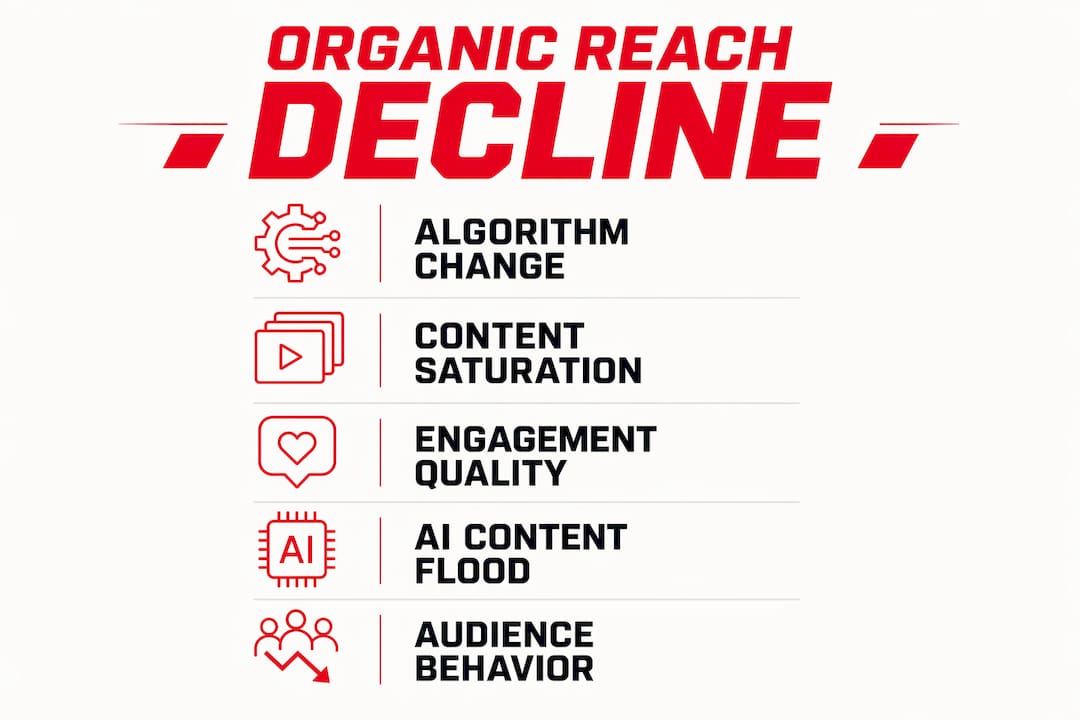
The AI volume problem compounds these issues. As AI-generated content floods the platform, Instagram's quality filters have become more aggressive. The algorithm now favors content that reflects real human experience and niche expertise over polished, generic production.
How user behavior is shrinking your Instagram reach
The algorithm does not operate in a vacuum. It responds to how real people use the app, and user behavior has shifted dramatically.
Users scroll faster, follow fewer accounts, and abandon content that does not grab them in the first moment. Instagram's opening-seconds test determines whether a post gets pushed further based on those early signals. A weak hook does not just lose that viewer. It signals to the algorithm that the content is not worth distributing broadly.
"Instagram does not penalize accounts. It matches the algorithm to evolving user behavior around deep engagement." This distinction matters because it reframes the problem. The platform is not working against you. It is reflecting what your audience actually does.
The content saturation problem is real. The supply of posts has grown far beyond the finite attention users have available. As a result, users have become more selective. They engage privately rather than publicly. They save posts they find useful. They share Reels to friends via DM. They rarely double-tap anymore.
Raw, human-centric content outperforms polished, branded content in algorithm recommendations and non-follower feeds. The shift penalizes overly produced brand content in favor of authenticity. A fitness coach filming a genuine workout struggle in a gym mirror will often outperform a brand with a $5,000 production budget. That is not a bug. It is the algorithm reflecting what users actually watch and share.
What causes sudden Instagram reach drops?
Not every reach drop is the result of a long-term algorithm shift. Some drops are mechanical, and they have specific causes and recovery timelines.
- Hook rate collapse. If your last several posts had weak opening frames, the algorithm's initial test audience dropped off early. The fix is improving your first two seconds, not changing your entire content strategy.
- Posting cadence disruption. Going silent for two or more weeks and then posting a burst of content triggers a cold start. The algorithm treats the account as newly active and limits initial distribution until it can re-evaluate performance.
- Originality flag. Hitting the 10-repost threshold in 30 days removes your content from non-follower surfaces. Recovery requires 14–21 days of consistent original content before distribution normalizes.
- Community guideline flags. A flagged post suppresses distribution on that post and can temporarily reduce reach across the account. Reviewing flagged content and removing or editing it speeds recovery.
- Format mismatch. Posting static images in a Reels-dominated feed reduces overall account reach scores. Static images dropped 17% year over year. Shifting toward video formats signals alignment with current platform priorities.
Mechanical fixes typically manifest within 5–14 days after identifying and correcting the root cause. Consistent high-signal posting during that window is the fastest path back.
Pro Tip: Run a simple audit before assuming the worst. Check your hook rate (what percentage of viewers watch past three seconds), your posting consistency over the last 30 days, and your repost count. Most sudden drops trace back to one of these three factors.
Strategies to restore and grow organic reach in 2026
Adapting to Instagram's current algorithm requires a shift in how you think about content, not just what you post.
Optimize Reels for retention and loop effect
High retention on short micro-Reels of 7–15 seconds with satisfying loops signals quality better than longer content with early drop-off. A loop effect, where the end of the video connects back to the beginning, increases watch time without requiring longer content. Pair that with a strong first-frame hook and you have the two most important retention drivers on the platform.
Build for private engagement signals
Reels that spark private conversations and maintain 60%+ viewer retention get pushed to recommendation surfaces. Design content that makes viewers want to send it to someone. Ask yourself: "Would someone DM this to a friend?" If the answer is no, the content is likely optimized for passive scrolling rather than genuine engagement.
Prioritize original, niche-consistent content
The originality penalty is not just a technical rule. It reflects a platform-wide preference for creators who add something new. Niche-consistent original content builds a clear identity that the algorithm can match to the right non-follower audiences. Broad, generic content gets matched to no one in particular.
Engagement rate relative to reach matters more than follower count. Accounts with high engagement on smaller audiences consistently outperform large but disengaged accounts in distribution. Growing a smaller, genuinely interested audience is more valuable than inflating follower numbers.
Respond early and engage your community
The first 30–60 minutes after posting are critical. Responding to comments quickly signals to the algorithm that the post is generating real interaction. Asking a direct question in your caption or Reel drives comment activity. Early engagement creates a positive feedback loop. The algorithm rewards you with more reach, which brings more engagement, which brings more reach.
Key takeaways
Instagram's organic reach is declining because the platform now distributes content based on deep engagement quality, not follower count or posting volume.
| Point | Details |
|---|---|
| Reach is based on engagement quality | Average organic reach fell to 3.8% in 2026; engagement rate and saves matter more than likes. |
| Algorithm rewards private signals | Shares, DMs, and saves carry more weight than public likes in content distribution decisions. |
| Originality is enforced | Ten or more reposts in 30 days removes accounts from non-follower discovery surfaces. |
| Sudden drops are usually mechanical | Most overnight reach drops recover within 5–21 days with consistent original posting. |
| Micro-Reels with loops outperform | Short Reels of 7–15 seconds with high retention and loop effects drive the most recommendation reach. |
The uncomfortable truth about chasing reach
I have watched creators and marketers spend months trying to reverse reach declines by posting more, switching formats every two weeks, and chasing whatever format went viral last month. Almost none of it works. The accounts that recover and grow are the ones that stop treating reach as the goal and start treating genuine audience connection as the goal.
The reach drop is real. But it is also a filter. Instagram is getting better at separating content that people actually value from content that was designed to game a metric. That is uncomfortable if your strategy was built around volume and vanity metrics. It is an opportunity if your strategy is built around a real audience with a real reason to follow you.
The biggest mistake I see is abrupt pivots. A creator who has built a following around educational carousels suddenly abandons them for daily Reels because they read that Reels get more reach. The algorithm does not reward format switches. It rewards consistency and engagement depth within a niche. Test new formats gradually. Keep what works. Do not burn your existing audience to chase a trend.
The creators who are winning right now are not the ones with the biggest budgets or the most posts. They are the ones who know exactly who they are talking to and make content that person genuinely wants to share. That has always been the point. The algorithm just makes it harder to fake.
— Zen
How Sogrow helps you grow through algorithm changes
Adapting to Instagram's 2026 algorithm is not just about knowing what changed. It is about having the right system to act on that knowledge consistently.
Sogrow uses AI-powered analysis to help creators and marketers identify what their audience actually engages with, then build a content strategy around those signals. The platform focuses on attracting real followers who are genuinely interested in your content, not inflated numbers that drag down your engagement rate. Clients have grown from 2,000 to 18,000 followers and tripled engagement rates within weeks by aligning their content with what the algorithm now rewards. If you are ready to stop guessing and start growing, explore Sogrow's growth tools and see what a data-driven approach looks like in practice.
FAQ
Why did my Instagram reach drop suddenly?
Sudden reach drops are usually mechanical, not penalties. Common causes include a weak hook rate on recent posts, a posting cadence disruption, or hitting the 10-repost threshold in 30 days.
How long does it take to recover Instagram reach?
Most mechanical reach drops recover within 5–21 days with consistent, original, high-signal posting. Originality-related drops take the full 14–21 days.
What content format gets the most organic reach on Instagram in 2026?
Short Reels of 7–15 seconds with high viewer retention and a loop effect currently drive the most recommendation reach on the platform.
Do more followers mean more organic reach?
No. Engagement rate relative to reach outweighs follower count in Instagram's distribution model. A smaller, highly engaged audience consistently gets more reach than a large, disengaged one.
What signals does Instagram's algorithm prioritize in 2026?
Instagram prioritizes watch time, viewer retention, saves, shares, and DMs over public likes. Private engagement signals indicate genuine content value and trigger broader distribution.