
Why Engagement Rate Drops for Creators in 2026
Your engagement rate is falling. Your follower count is climbing. And you're wondering what you did wrong.
Here's the truth: you probably didn't do anything wrong. Engagement rate drops for creators are driven by forces that have nothing to do with content quality alone. In 2026, the combination of algorithm overhauls, audience behavior shifts, and content saturation has pushed engagement rates down roughly 24% year-over-year on Instagram, while LinkedIn carousels have mediated a 6.2% engagement rate. The core reasons come down to five compounding factors:
- Algorithms now reward shares, saves, and watch time over likes and comments
- Larger audiences contain more passive, less-targeted followers
- Content competition has exploded faster than audience attention has grown
- Private engagement (DMs, group chats) replaces public interaction without showing up in your metrics
- Content drift pulls creators away from the niche that built their audience in the first place
Understanding these causes is the first step. Knowing what to do about them is what separates creators who recover from those who keep chasing the wrong metrics.
Why engagement rate drops: how algorithm changes are reshaping reach
Every major platform rewrote its distribution rules between 2024 and 2026, and the shift hit creators hard. The old model rewarded likes and comments. The new model rewards intent signals: saves, shares, watch time, and DM sends. If you were optimizing for likes, your strategy became outdated almost overnight.

Instagram's 2026 algorithm ranks content by a specific signal hierarchy: DM sends first, then saves, then watch time on Reels, then profile clicks, and finally likes. A post with 100 likes and 20 DM shares now reaches more people than one with 500 likes and zero shares. Likes, once the clearest signal of success, now sit at the bottom of the stack.
TikTok operates differently but with the same underlying logic. Completion rate is the primary distribution gate. If viewers don't watch your video to the end, the platform stops pushing it to new audiences. Likes are a secondary signal at best. Meanwhile, Facebook grew engagement year-over-year because its algorithm still weights comments heavily, rewarding content that sparks real conversation threads.
Platform-specific signals creators should track in 2026:
- Instagram: DM sends, saves, Reels watch time, profile clicks
- TikTok: completion rate, shares, comments, then likes
- LinkedIn: carousel engagement, dwell time, comment depth
- Facebook: comment threads, reply chains, reaction diversity
Organic reach has also been squeezed by platform business models pushing paid promotion. Facebook's organic reach for business pages is quite limited, meaning a page with many followers might reach only a small fraction per post. That structural ceiling makes engagement rate drops feel personal when they're actually systemic.
Stat to know: Average comments per post fell on TikTok and Instagram year-over-year, while shares per post increased significantly on both platforms. People are still engaging. They're just doing it differently.
Why authenticity and content relevance determine who survives the decline
The rise of AI-generated content has created a paradox: more content, less connection. Only 37% of users engage with content they perceive as AI-generated, and many are less likely to interact with posts that feel machine-made. Audiences have developed a sharp instinct for "sameness," and they scroll past it without a second thought.
What cuts through is the human side. Creators who show imperfect, behind-the-scenes moments, who reply to comments with personality, and who hold a consistent point of view are outperforming polished, generic accounts. The data backs this up: 73% of consumers say they will switch to a competitor if a brand fails to show a human side in the comment section. That number applies to creators just as much as brands.
Content drift is the quieter killer. An account that built its audience around fitness tips starts posting lifestyle content. A cooking creator pivots to personal vlogs. The existing audience wasn't there for that shift, so they stop engaging. The algorithm notices the drop in interaction rate and reduces distribution. Reach shrinks. The creator assumes the algorithm is punishing them, when the real issue is that the content no longer matches the audience's expectations.
- Audit your last 20 posts against the content that originally grew your account
- If the topic, tone, or format has shifted significantly, that drift is likely the cause of declining interaction
- Realigning with your original niche value has proven to be an effective remedy for sudden engagement drops
Pro Tip: Disrupt your content pattern intentionally every 8–12 weeks. Not by changing your niche, but by introducing a new format, a fresh series, or a different angle on your core topic. This breaks audience fatigue without breaking the relevance that keeps your followers engaged.
How passive consumption is quietly killing your visible metrics
Your audience didn't stop caring. They stopped announcing it. This is the passive consumer phenomenon, and it's one of the most misunderstood causes of declining engagement for creators.
Likes and comments are dropping while sharing and watch time are increasing. Users are watching, reading, and evaluating content, but they're doing it silently. They send your Reel to a friend in a DM, save your carousel for later, and never leave a public trace. Your analytics show a flat engagement rate. The reality is that your content may be working harder than it looks.
"Content is being watched, read, and evaluated, but much of that happens quietly now. Posts are reaching people. Videos are getting views. But the visible signals — likes, comments, shares — don't match that growth." — Beacon Media + Marketing
The shift toward private interaction is structural. People are moving conversations into DMs, group chats, and niche communities. Public comments require more social exposure than most users want to offer. Faster scrolling and sharper content filtering mean that even genuinely interested followers interact less spontaneously than they did two years ago.
The practical implication: stop measuring success by likes alone. Shift your focus to saves, watch time, DM sends, and profile visits. These signals tell you whether your content is actually resonating, even when the public numbers look quiet. Creators who make this mental shift stop chasing the wrong metrics and start building content that earns the signals platforms actually reward.
Platform-specific engagement trends: Instagram, TikTok, LinkedIn, and Facebook
The 2026 engagement picture looks very different depending on which platform you're on. A blanket strategy across all four will underperform on every one of them.
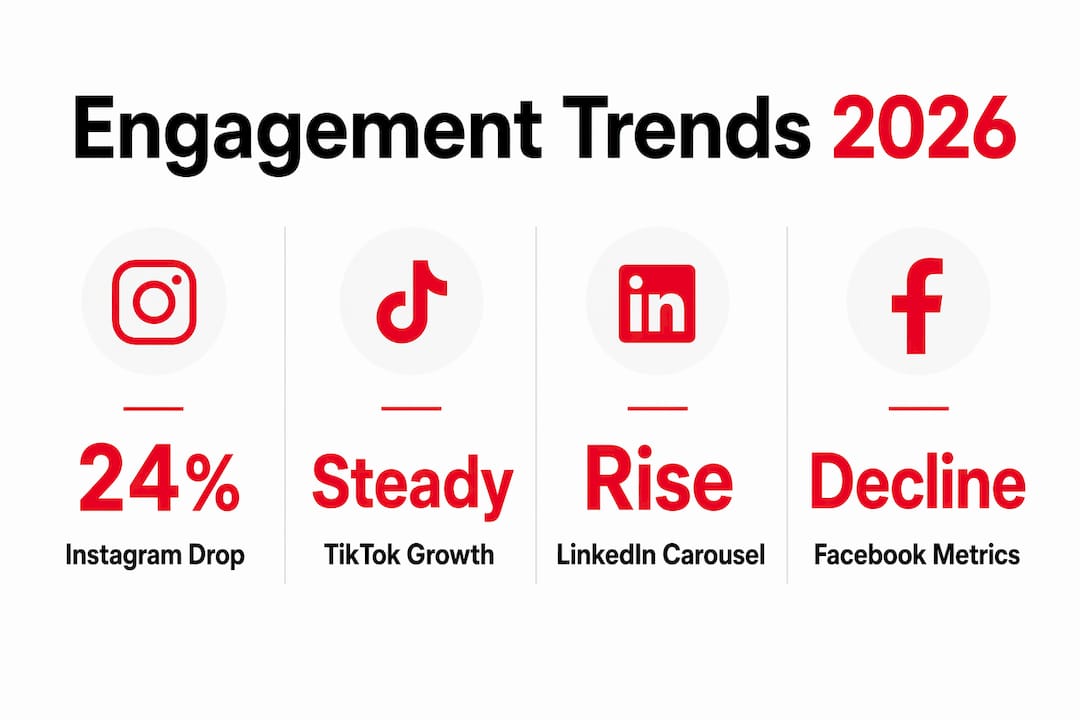
| Platform | Median Engagement Rate | Key Trend | Top-Performing Format |
|---|---|---|---|
| 24% decline YoY | Reels and carousels dominate; static posts declined sharply | Reels for reach, carousels for saves | |
| TikTok | — | Completion rate is the primary distribution gate | Short-form video with strong hooks |
| 6.2% for carousels | Rising engagement; professional trust content wins | Carousels, text posts with a personal angle | |
| engagement grew year-over-year | Comments weighted most heavily by algorithm | Conversation-driven posts, community content |
Instagram's decline is the steepest and most discussed. The platform's median engagement rate has dropped by 24% year-over-year, driven by algorithm changes, content volume explosion, and the shift toward private sharing. Carousel posts now generate higher engagement than Reels on Instagram, though Reels still reach more non-followers. Static single-image posts have seen the steepest drop of all formats.
LinkedIn is the outlier. While other platforms are contracting, LinkedIn's carousel format pulls a median engagement rate of 6.2%, driven by the platform's professional trust environment and content style that rewards depth over virality. Text posts with a clear personal angle also outperform link posts significantly, because LinkedIn's algorithm deprioritizes external links.
TikTok still leads on raw engagement but faces growing saturation. The platform's average engagement rate has eased recently, and algorithm updates increased the weight of watch time completion relative to likes. Creators who relied on like-baiting tactics saw their rates drop sharply after that update.
Pro Tip: Don't cross-post identical content across platforms. Each platform rewards different formats and signals. A carousel that performs well on LinkedIn needs a different hook and structure than one built for Instagram. Adapt the format, not just the caption.
Effective strategies to recover from declining engagement
Recovery starts with diagnosis, not action. Creators who jump straight to "post more Reels" without understanding whether the problem is algorithmic suppression, content fatigue, or audience drift end up changing the wrong things.
Run a diagnostic across your last 10 posts. Check three numbers: non-follower reach percentage, completion rate on videos, and DM shares. If non-follower reach is under 5%, the algorithm has stopped distributing your content to new people, which could indicate a shadowban or algorithm distrust from inconsistent posting. If completion rate is under 30%, the problem is your hooks. If DM shares are at zero, your content isn't triggering the share impulse that Instagram's algorithm weights most heavily.
Once you've identified the cause, apply targeted fixes:
- Build conversation, not broadcasts. Reply to every comment within the first hour after posting. That window is when the algorithm decides how widely to distribute your content. Fast early engagement signals resonance and triggers broader reach.
- Vary your formats deliberately. Carousels drive saves and shares. Short-form video drives reach. Mix them based on your goal for each post, not out of habit.
- Post with regularity, not volume. Accounts that maintain a steady cadence outperform those that post in bursts followed by silence, even when the burst accounts publish more total content. Three consistent posts per week beats ten posts in one week followed by two weeks of silence.
- Optimize for shares and saves as primary goals. Create content users feel compelled to send to someone else. A like is passive. A share requires a decision. Build content around that higher bar.
- Build an email list. Reducing dependence on platform algorithms is the most durable long-term strategy. An owned email list gives you direct access to your audience regardless of what any platform decides to change next quarter.
The creators seeing growth in 2026 are treating each post as the start of a conversation, not the end of a content cycle. They ask questions in captions, respond to replies, and use AI tools to stay consistent without burning out. Understanding how AI is changing social media marketing can help you use these tools to support your strategy without falling into the trap of generic, low-engagement content.
Pro Tip: If your engagement doesn't improve after a focused 7-day sprint of consistent posting, reply engagement, and format variation, the issue may be a shadowban rather than content quality. Run the shadowban diagnostic: check whether your hashtags appear in search results and whether your content shows on non-followers' feeds. If neither is true, remove any flagged content, avoid restricted hashtags, and wait 7–14 days before reassessing.
Key Takeaways
Engagement rate drops for creators in 2026 are driven by algorithm shifts, passive audience behavior, and content saturation, not content failure alone.
| Point | Details |
|---|---|
| Algorithm signals changed | Platforms now prioritize DM sends, saves, and watch time over likes, requiring creators to optimize for different behaviors. |
| Platform trends vary widely | Instagram's median rate dropped significantly; LinkedIn carousels pull notably higher median engagement, and Facebook's engagement grew year-over-year. |
| Passive consumption is rising | Likes and comments drop while sharing and watch time increase; measure saves and DM sends, not just public reactions. |
| Content drift costs reach | Drifting from your original niche reduces audience interaction and triggers algorithmic distribution penalties. |
| Consistency beats volume | Accounts posting on a regular cadence outperform burst posters, even when burst accounts publish more total content. |
Sogrow helps you grow real engagement on Instagram
If your Instagram numbers have stalled, the problem usually isn't effort. It's strategy and audience alignment. Sogrow's AI-powered approach targets real followers who are genuinely interested in your content, not bots that inflate your count and tank your engagement rate.
Creators using Sogrow have gone from 2K to 18K followers while tripling their engagement rates, not by gaming the algorithm, but by attracting the right audience from the start. As of 2026, Instagram engagement rates have dropped roughly 24% year-over-year, so achieving higher engagement requires consistent niche alignment and audience intent. When your followers actually care about what you post, the flywheel starts turning on its own. The algorithm rewards you with more reach, more reach brings more real followers, and the cycle builds.
Start growing with Sogrow and put your Instagram engagement back on track with followers who actually show up.