
What Is the Instagram Algorithm? Your 2026 Guide
The Instagram algorithm is defined as a collection of multiple AI-powered ranking systems that decide which content each user sees across Feed, Stories, Explore, and Reels. There is no single algorithm. Instagram Head Adam Mosseri has confirmed that four distinct AI systems tailor content separately for each section of the app. Each system reads thousands of signals, from relationship history to watch time, to predict what you want to see next. Understanding how these systems work is the clearest path to growing your reach without paying for ads or buying fake followers.
What is the Instagram algorithm, and why does it matter?
The Instagram algorithm is not one gatekeeper. It is a set of AI systems, each with its own rules, candidate pools, and ranking priorities. That distinction matters because a strategy built for Feed will not automatically work for Reels or Explore.
The core purpose of every Instagram AI system is the same: maximize time spent on the app by surfacing content each user finds most relevant. Instagram earns revenue through attention. The longer users stay, the more ads they see. Every ranking decision flows from that commercial reality.

Two metrics sit at the top of the signal hierarchy in 2026. The first is Views, which counts every time content appears on a screen. The second is Sends per Reach, which measures how often a post is shared via DM relative to how many people saw it. Sends per Reach outperforms likes and comments as a predictive distribution signal. A post that people share privately tells the algorithm it is genuinely valuable, not just scroll-stopping.
What are the different Instagram algorithms and how do they function?
Instagram operates four primary content surfaces, and each one runs on a different set of priorities.
| Surface | Primary goal | Top ranking signals |
|---|---|---|
| Feed | Relevance to existing connections | Relationship history, likes, comments, saves |
| Stories | Recency and closeness | DMs, story replies, viewing consistency |
| Explore | Discovery and interest matching | Saves, shares, popularity signals |
| Reels | Entertainment and virality | Watch time, replays, DM sends, audio trends |
Feed is the most relationship-driven surface. It pulls from accounts you already follow and ranks posts based on how often you interact with that account. A creator whose posts you comment on regularly will appear near the top of your Feed consistently.
Stories prioritize recency and closeness. The accounts whose Stories appear first are the ones you reply to, DM, and watch fully. Posting Stories at consistent intervals keeps you visible to your closest audience segment.
Explore works differently. It does not rely on existing relationships. Instead, it builds a candidate pool from posts that performed well with audiences similar to yours. Popularity signals like saves and shares carry more weight here than follower count.
Reels is the most entertainment-focused surface. The algorithm selects roughly 100 candidate videos based on predicted user interest, then ranks them by watch time, replays, and DM shares. Distinct algorithms require different content strategies per section, which means a one-size-fits-all posting plan will underperform on at least three of the four surfaces.
Which key signals drive Instagram algorithm rankings in 2026?
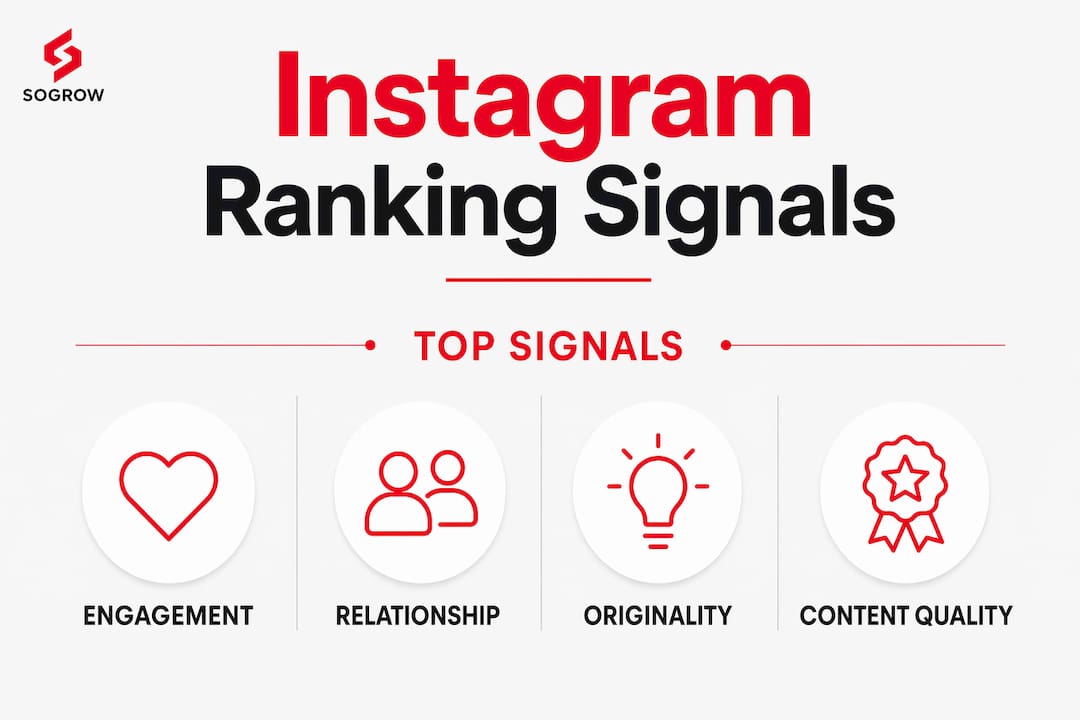
The ranking signals Instagram uses fall into three broad categories: engagement signals, relationship signals, and content quality signals.
Engagement signals
Views and Sends per Reach lead this category. Views count every screen appearance, including partial views in a scroll. Sends per Reach is the ratio of DM shares to total reach. A high ratio tells the algorithm that real people found the post worth recommending to someone they know. DM shares act as social proof, signaling personal recommendation and fueling wider distribution.
Watch time and retention are the dominant signals for video content. The first few seconds are decisive. Scroll-past events heavily penalize Reels and video posts in ranking. If viewers drop off in the first two seconds, the algorithm stops pushing the content to new users.
Relationship and originality signals
Relationship signals are the foundation of Feed and Stories ranking. Adam Mosseri has stated that consistent interactions, including DMs, comments, and story replies, are the strongest indicators that two accounts have a real connection. The algorithm rewards that connection with higher placement.
Originality is now a formal ranking factor. Instagram's Aggregator Penalty replaces reposted content with the original creator's post wherever possible. Accounts that repost without adding new value see their reach suppressed across recommendations. Creating original content is not just good practice. It is a technical requirement for full distribution.
| Signal | Type | Impact level |
|---|---|---|
| Sends per Reach | Distribution | Highest |
| Watch time and retention | Engagement | High |
| Relationship history | Relationship | High (Feed/Stories) |
| Saves | Engagement | Medium |
| Originality | Content quality | Medium to high |
| Hashtags | Discovery | Low |
Pro Tip: Focus your first caption line on a clear hook. Users who stop scrolling to read your caption generate a dwell-time signal that the algorithm counts as engagement, even without a like or comment.
How does Instagram's AI ranking process work behind the scenes?
The ranking process runs as a multi-stage funnel. Understanding the funnel shows you exactly where to focus your energy.
The funnel works in three steps:
- Candidate pool assembly: Instagram gathers a pool of eligible posts. Feed pulls roughly 500 posts from accounts you follow. Explore assembles approximately 1,500 posts from accounts you do not follow. Reels selects around 100 videos based on predicted interest.
- AI scoring: Each candidate post receives a score based on predicted user actions. The algorithm estimates the probability you will like, comment, share, or watch the full video. Posts with higher predicted engagement scores move forward.
- Final ordering: The top-scoring posts are ordered and delivered to your screen. The goal is to maximize the total time you spend in the session.
The funnel explains why immediate and strong engagement is so critical. A post that earns fast DMs and watch-throughs in its first hour signals high predicted engagement. The algorithm responds by expanding the candidate pool it tests the post against, pushing it to more users.
Pro Tip: Post when your most engaged followers are online. Early engagement velocity is the clearest signal the algorithm uses to decide whether to expand a post's reach to new audiences.
How can creators and brands work with the Instagram algorithm?
The most effective approach treats each Instagram surface as a separate channel with its own content brief.
Tailor content by surface
For Feed, prioritize posts that spark comments and saves. Carousels consistently generate higher save rates than single images because users swipe back to review the content. For Stories, post frequently and invite replies with polls, questions, and reaction stickers. Replies are relationship signals that lift your Stories ranking.
For Explore, design content around interest categories rather than your existing audience. Use strong visual hooks and optimize for saves. For Reels, the first two seconds determine everything. Open with motion, a bold statement, or a visual surprise. Retention in those early seconds decides whether the algorithm tests your video with a wider pool.
Build relationship signals deliberately
Relationship signals are built through consistent two-way interaction. Reply to every comment in the first hour after posting. Respond to DMs. Use Stories to have real conversations with your audience. These actions tell the algorithm that your account generates genuine connection, which lifts your Feed and Stories placement for those users.
Practical best practices
- Write captions with keywords in captions and your bio, not just hashtags. Keyword-based discovery now outperforms hashtag-based reach for most accounts.
- Never repost content without adding original commentary, context, or creative value. The Aggregator Penalty is real and measurable.
- Track your Sends per Reach metric in Instagram Insights. It is the clearest indicator of whether your content is earning distribution beyond your current followers.
- Create content that people want to send to a friend. Ask yourself: would someone DM this to someone they know? If the answer is no, rework the concept.
- Avoid posting at random intervals. Consistent posting schedules build viewing habits in your audience, which generates the recurring engagement signals the algorithm reads as relationship strength.
Key Takeaways
The Instagram algorithm is a set of distinct AI systems, and creators who treat each surface separately and prioritize Sends per Reach will consistently outperform those who chase likes alone.
| Point | Details |
|---|---|
| Multiple algorithms, not one | Feed, Stories, Explore, and Reels each use separate AI ranking systems with different signals. |
| Sends per Reach is the top signal | DM shares predict distribution better than likes or comments and push content to new audiences. |
| Watch time decides video reach | Losing viewers in the first two seconds stops the algorithm from expanding a Reel's audience. |
| Originality is now enforced | The Aggregator Penalty suppresses reposts and rewards accounts that create original content. |
| Keywords beat hashtags for discovery | Writing keyword-rich captions and bios now drives more algorithmic discovery than hashtag use. |
The signal that most creators are still ignoring
After watching hundreds of accounts grow and stall, the pattern is clear. Most creators obsess over likes and follower counts. The algorithm stopped caring about those metrics as primary distribution signals a long time ago.
The shift to Sends per Reach as the dominant signal changed everything. A post with 200 likes and 50 DM shares will outperform a post with 2,000 likes and 5 DM shares in terms of reach expansion. That is not intuitive, and most creators have not adjusted their content strategy to reflect it.
The other thing I have seen consistently is that creators who treat Instagram as one platform with one algorithm burn out fast and grow slowly. The accounts that scale are the ones that think in surfaces. They make Reels that are built to be shared. They make Stories that generate replies. They make Feed posts that earn saves. Each piece of content has a specific job on a specific surface.
The uncomfortable truth is that the algorithm is not your enemy. It is a system that rewards content people genuinely want to share with each other. Build for that, and the flywheel starts turning on its own.
— Zen
How Sogrow aligns with Instagram's algorithm to grow real audiences
Understanding the algorithm is one thing. Executing against it consistently is another challenge entirely.
Sogrow is an AI-powered growth platform built specifically for creators and brands who want real followers, not inflated numbers. Sogrow analyzes your account's performance signals, including Sends per Reach and engagement patterns, and helps you build a content and targeting strategy that works with the algorithm rather than against it. Clients have grown from 2,000 to 18,000 followers and tripled their engagement rates within weeks. If you are ready to grow an audience that actually engages, start with Sogrow and put the algorithm to work for you.
FAQ
What is the Instagram algorithm in simple terms?
The Instagram algorithm is a set of AI systems that decide which posts each user sees across Feed, Stories, Explore, and Reels. Each system ranks content based on signals like relationship history, watch time, and DM shares.
How does the Instagram algorithm decide what to show first?
The algorithm builds a candidate pool of posts, scores each one based on predicted user actions like likes, comments, and shares, then orders the top-scoring posts for delivery. Immediate engagement after posting is the strongest signal for expanding reach.
What is the most important signal for the Instagram algorithm in 2026?
Sends per Reach is the strongest distribution signal. When users share a post via DM relative to how many people saw it, the algorithm treats that as proof the content is worth showing to a wider audience.
Does posting more often help with the Instagram algorithm?
Consistent posting builds viewing habits and relationship signals, which improves ranking in Feed and Stories. However, posting frequency without strong engagement signals does not guarantee wider reach on Explore or Reels.
Do hashtags still work with the Instagram algorithm?
Hashtags have lost their effectiveness as a primary discovery tool. Keywords placed in captions and profile bios now drive more algorithmic discovery than hashtag strategies for most accounts.