
Instagram Brand Affinity: What Marketers Need to Know
Instagram brand affinity is the quantifiable emotional bond between a brand and its Instagram audience, measured through specific interaction signals. Think of it as a score that tells you how much an influencer's followers genuinely care about a brand, not just whether they scroll past it. Affinity is calculated by aggregating five core engagement signals:
- @mentions of a brand in posts, Stories, carousels, or videos
- Hashtags referencing a brand in captions or comments
- Location tags at brand-affiliated venues like stores, restaurants, or hotels
- Follows of a brand's official Instagram account
- Likes on content published by a brand's official page
The resulting score is relative, not absolute. A score of 1.0 means an audience interacts with a brand at the same rate as the average Instagram user. A score of 2.0 means they are twice as interested compared to that baseline. For marketers and influencers, this metric is a diagnostic tool. It reveals whether an influencer's audience is already predisposed to a brand before any paid collaboration begins.
Table of Contents
- What is Instagram brand affinity and how is it calculated?
- Why brand affinity matters more than follower count
- How to build brand affinity on Instagram
- Common misconceptions about Instagram brand affinity
- What the research says about brand affinity and Instagram performance
- Key Takeaways
- Grow real affinity with real followers
What is Instagram brand affinity and how is it calculated?
The calculation behind an affinity score pulls from every measurable touchpoint between an audience and a brand on Instagram. Platforms that surface this metric aggregate the five signals above across an influencer's follower base, then compare that activity against the platform-wide average to produce a relative score.
Here is what each threshold means in practice:
- Score below 1.0: The audience interacts with this brand less than the average Instagram user. Proceed with caution.
- Score of 1.0: Baseline interest. The audience is neither unusually engaged nor disengaged with the brand.
- Score above 1.0: Above-average interest. The higher the score, the more organically this audience gravitates toward the brand.
- Score of 2.0 or higher: Strong affinity. Prioritize influencers with scores significantly above 1.0 for authentic audience fit.
One critical nuance: affinity scores should always be read against category averages, not just the platform-wide baseline. A score of 1.5 in a niche fitness community carries different weight than 1.5 in a broad lifestyle category. The former signals genuine, concentrated interest. The latter might just reflect a popular trend. Data sources feeding these calculations include public post captions, Story interactions, tagged locations, and follow activity, all pulled from Instagram's accessible engagement layer.
Why brand affinity matters more than follower count
Follower count tells you how many people could theoretically see a post. Brand affinity tells you how many of them actually care. That gap is where most influencer campaigns either win or waste budget.
Brand affinity is the emotional connection that links customers to a brand, formed through shared values, experiences, or personality. On Instagram, that connection surfaces as repeated, voluntary interaction, not passive consumption. An audience with high affinity for your brand is already warmed up. They mention you without being asked, tag your locations, and follow your account because they want to, not because an algorithm pushed your content into their feed.
For marketers, the practical benefits are direct:
- Influencer vetting: Affinity scores surface creators whose audiences are genuine organic fans, not just large crowds with no brand alignment.
- Campaign efficiency: High-affinity audiences convert at higher rates because the emotional groundwork is already laid.
- Partnership authenticity: Collaborations feel natural when an influencer's followers already interact with your brand, which protects credibility on both sides.
- Audience targeting: Affinity data helps you identify which audience segments to prioritize in paid campaigns and retargeting.
Loyalty-driven KPIs are a critical component of Instagram marketing strategies focused on influencer collaborations, because they more accurately reflect engaged and monetizable audiences than raw reach numbers ever will.
How to build brand affinity on Instagram
Building affinity is not a single tactic. It is a flywheel. Every genuine interaction you earn feeds the next one, and the algorithm rewards you with more reach as a result.
- Use Stories for connection, Reels for discovery. Reels are built for discovery and help new audiences find you. Stories are built for connection and keep you top of mind with people who already know your brand. Use both, but do not confuse their jobs.
- Respond to comments and mentions promptly. Authentic affinity builds through humanized engagement. Prompt responses, live Q&As, and user-generated content reinforce emotional bonds that go well beyond transactions.
- Encourage user-generated content (UGC). Ask followers to tag your brand, repost their content, and highlight their stories. Customers who create UGC are clear indicators of genuine affinity.
- Maintain a consistent brand voice and aesthetic. Recognition builds trust. A cohesive visual identity and tone across every post, Story, and Reel signals to both followers and the algorithm that your account has a clear identity.
- Use branded hashtags strategically. A branded hashtag serves as a call to action. It encourages followers to tag your brand and creates a searchable community thread that compounds over time.
- Host live Q&A sessions. Live interaction humanizes your brand faster than any static post. It is often the most direct way to build an immediate emotional connection with your audience.
Pro Tip: Balance your content calendar deliberately. Aim for a mix where roughly half your posts prioritize reach (Reels, trending hashtags) and the other half prioritize depth (Stories, UGC reposts, direct replies). Brands that focus only on reach formats risk high vanity metrics but low true engagement, which is the exact opposite of what affinity building requires.
A strong content strategy for Instagram ties these tactics together into a repeatable system rather than a series of one-off posts. Consistency is what separates brands that build lasting affinity from those that spike and fade.

Common misconceptions about Instagram brand affinity
A high affinity score is not a guarantee of anything on its own. Misreading it leads to poor influencer decisions and wasted spend.
- Affinity is not the same as reach. An influencer with 500,000 followers and a low affinity score for your brand is a weaker partner than one with 50,000 followers and a score well above 1.0. The size of the audience is irrelevant if they do not care about your category.
- High affinity does not mean a paid partnership exists. High affinity scores identify organic fans who can become authentic collaborators. They do not confirm any commercial relationship.
- Affinity alone does not predict conversion. An audience that loves your brand on Instagram still needs the right offer, timing, and call to action to convert. Affinity raises the probability; it does not close the sale.
- A score of 1.0 is not a failure. It means average interest. For broad consumer brands, a baseline score across a large audience can still represent real volume. Context matters.
- Affinity scores are community-specific. A score that looks modest in one niche might be exceptional in another. Always compare against category benchmarks, not just the platform average.
The right approach is to use affinity as one signal within a broader set of KPIs. Pair it with engagement rate, save rate, and sentiment analysis for a complete picture.
What the research says about brand affinity and Instagram performance
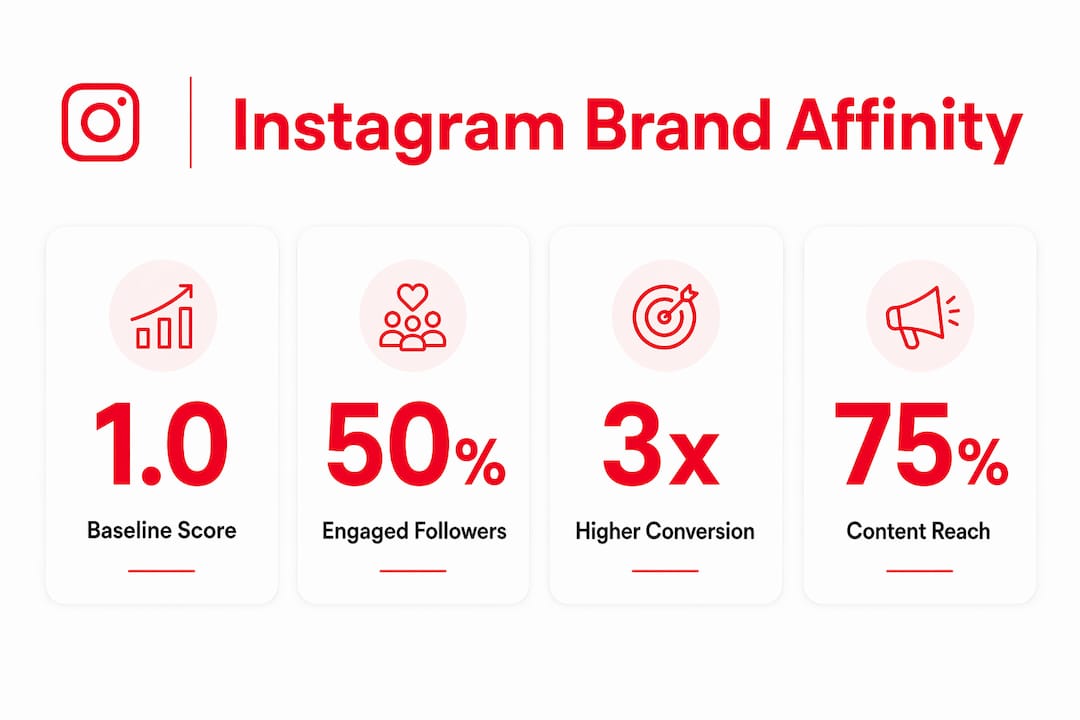
The data on Instagram engagement and revenue paints a nuanced picture, and it is worth understanding before you build your measurement framework.

Research published in the journal Information introduced a "loyalty rate" metric that combines a page's interaction rate with its virality rate to measure follower loyalty. The study found a moderate positive correlation between this loyalty rate and revenue (r = 0.423), though the result did not reach statistical significance (p = 0.116). The takeaway is not that loyalty metrics are useless. It is that no single metric tells the whole story.
| KPI | What it measures | Affinity relevance |
|---|---|---|
| Affinity score | Relative audience interest in a brand | Primary signal for influencer fit |
| Engagement rate | Likes, comments, shares per post | Validates affinity with active behavior |
| Save rate | Content saved by followers | Predicts intent and loyalty |
| Virality rate | Shares extending reach beyond followers | Measures organic amplification |
| Loyalty rate | Interaction rate + virality rate combined | Broader indicator of monetizable audience |
| Sentiment analysis | Tone of brand mentions | Qualifies affinity as positive or negative |
Expert consensus reinforces what the data suggests: authentic community engagement and a consistent brand voice are the primary drivers of affinity, not posting frequency or ad spend. Brands that show up genuinely, respond to their communities, and create content worth saving tend to accumulate affinity over time. Those chasing reach alone end up with large audiences that feel nothing in particular about them.
The most effective metric to predict sustainable brand growth on Instagram is a loyalty rate combining follower interaction and content virality, not raw follower count. That finding should reshape how you report on Instagram performance internally.
Key Takeaways
Instagram brand affinity is a relative, interaction-based score that predicts audience alignment with a brand, and it outperforms follower count as a predictor of authentic engagement and influencer fit.
| Point | Details |
|---|---|
| Affinity score baseline | A score of 1.0 equals average Instagram user interest; 2.0 means twice that level of engagement with a brand. |
| Five core signals | Affinity aggregates @mentions, hashtags, location tags, follows, and likes of official brand content. |
| Influencer selection | Prioritize creators with affinity scores significantly above 1.0 for genuine audience alignment. |
| Loyalty rate insight | Combining interaction rate and virality rate into a loyalty rate offers a stronger view of monetizable audiences than follower count alone. |
| Build affinity deliberately | Stories deepen connection with existing followers; Reels expand reach to new ones. Use both with intention. |
Grow real affinity with real followers

Affinity scores only move when real people genuinely engage with your brand. That means the foundation has to be right: an audience of actual followers who care about your content, not inflated numbers that hollow out your metrics.
Sogrow's AI-powered approach targets exactly that. We focus on attracting followers who are already interested in your niche, so every affinity signal you earn reflects genuine audience connection. Fitness coaches, creators, and brands have grown from 2K to 18K followers and tripled their engagement rates using Sogrow's platform, turning their Instagram accounts into real revenue channels.
Start growing on Instagram with an audience that actually moves your affinity scores.