What Is Content Fatigue on Instagram? 2026 Guide
Content fatigue on Instagram is defined as the state where creators and audiences experience declining engagement, reduced motivation, and burnout caused by repetitive, high-frequency, or low-quality content. It is the recognized industry term for what many creators loosely call "Instagram content burnout," and the two phrases describe the same condition. The scale of this problem is striking: 62% of full-time creators reported severe burnout symptoms in 2026, and Instagram specifically showed a 61% burnout rate tied directly to daily posting demands. If your engagement is dropping and posting feels like a chore, you are not alone, and the platform itself is partly responsible.
What is content fatigue on Instagram, and why does it matter?
Content fatigue on Instagram is not a motivation problem. It is a structural one. Instagram's algorithm rewards consistent, original, high-performing content, which creates a pressure loop that pushes creators to post more, faster, and with less recovery time. 88% of creators identify Instagram as a primary burnout driver, and 70% report that algorithmic unpredictability causes them ongoing anxiety. That combination of relentless output pressure and unpredictable results is what makes Instagram uniquely exhausting compared to other platforms.
The consequences extend beyond the creator. When a creator burns out, their content quality drops, their posting frequency becomes erratic, and their audience disengages. Audience-side content fatigue is the mirror image: followers who see too much repetitive content start scrolling past without interacting, which the algorithm reads as low relevance and reduces reach further. The cycle feeds itself.

What causes content fatigue on Instagram?
Several forces combine to produce content fatigue, and understanding each one helps you address the right problem.
- High posting frequency demands. Instagram's algorithm historically rewards accounts that post daily or near-daily. That pace creates what creators call "content debt," where you owe the algorithm more content than you can sustainably produce.
- Algorithmic unpredictability. A post that performed well last week may get no traction this week for no visible reason. That unpredictability makes it hard to feel rewarded for effort, which deepens emotional exhaustion.
- Originality penalties. Instagram penalizes reposted content heavily. Accounts that post more than 10 unoriginal pieces in 30 days risk removal from recommendation surfaces for 30 days. That policy forces creators to generate fresh ideas constantly, even when they are already depleted.
- Reels dominance. The shift toward short-form video raised the production bar significantly. A static image post takes 20 minutes. A Reel with audio, captions, and editing can take 3 hours. That format shift multiplied the time cost of staying relevant.
- Metric-driven self-worth. Psychologist Maria Conceição's 2026 analysis found that creators link engagement metrics to self-worth, which deepens burnout beyond physical exhaustion into psychological territory. A bad week of reach feels like personal failure.
Pro Tip: Track your emotional response to posting, not just your metrics. If you feel dread before hitting "share," that is a burnout signal worth acting on before your output quality drops.
What are the signs of content fatigue in creators and audiences?
Recognizing fatigue early is the difference between a manageable slump and a full account collapse. The signs split into two categories: what happens to you, and what happens to your audience.
Creator-side symptoms
- Dreading the content calendar. Tasks that once felt creative now feel mechanical. You are filling slots, not making things.
- Declining post quality. You notice your captions are shorter, your visuals are less considered, and your ideas are recycled.
- Physical exhaustion tied to posting. Headaches, poor sleep, and irritability that cluster around content creation days are physical burnout markers.
- Loss of audience connection. You stop caring whether your content resonates. You just want it done.
- Considering quitting. 47% of creators considered quitting in the six months before a 2026 survey. That figure shows how far fatigue can progress before creators take action.
Audience-side symptoms
"Scroll fatigue is the audience equivalent of creator burnout. When followers stop commenting, stop saving, and start swiping past your content without pausing, they are telling you the content no longer earns their attention."
Reduced saves and shares are the clearest early signal. Comments drop before likes do, because commenting requires more effort. If your reach is stable but saves and shares have fallen, your audience is still seeing your content but no longer finding it worth keeping. That gap between reach and depth of engagement is the first measurable sign of audience-side fatigue.
Creators must also distinguish between a seasonal slump and true burnout. A seasonal slump responds to lighter, connection-focused posts and usually resolves within two to three weeks. True burnout requires systemic workflow changes, not just a content pivot.
How to reduce content fatigue on Instagram
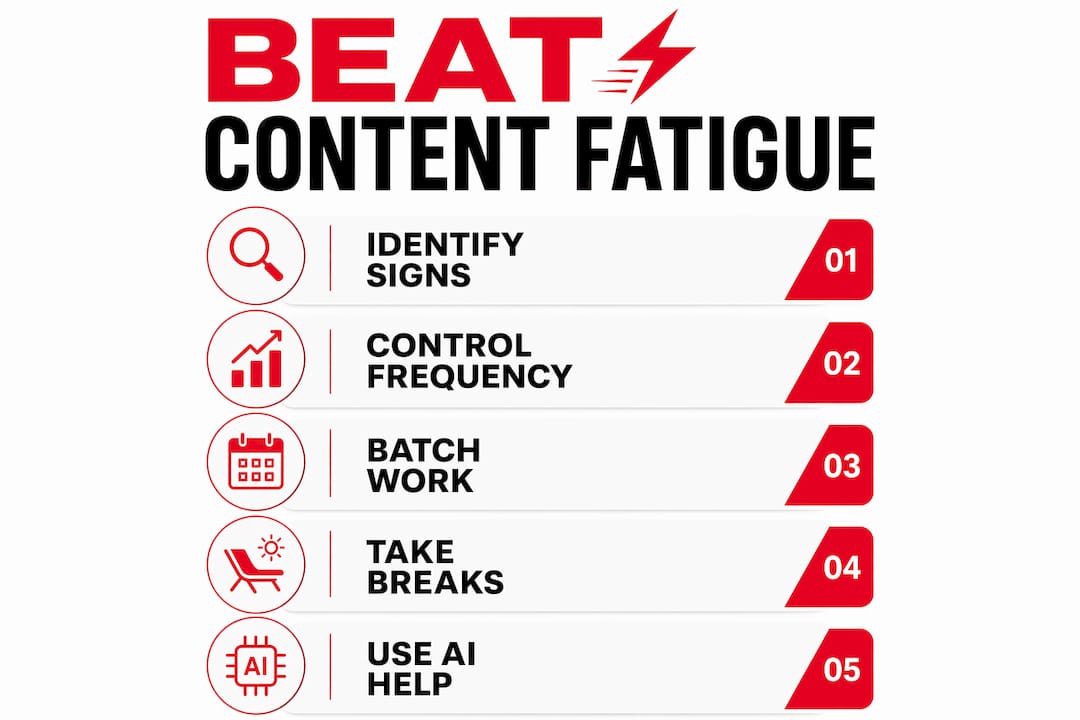
The most effective approach to reducing content fatigue combines posting frequency control, batching, AI-driven personalization, and intentional recovery periods.
Control your posting frequency
The safe weekly ceiling for short-form content is 3–4 posts, with 5 as the upper burnout risk limit. Posting more than that does not proportionally increase reach, but it does proportionally increase exhaustion. Staying at 3–4 posts per week gives the algorithm enough signal to rank your content while protecting your creative capacity.
Batch your content production
Most creators overestimate how long content creation takes. Practitioners use 30-minute power hours and batch 3–4 posts in a single session to maintain quality and consistency without daily output pressure. Batching separates the creative phase from the publishing phase, which reduces decision fatigue and keeps your content calendar full without daily effort.
Use AI-driven personalization
AI-powered tools reduce ideation and posting hours by 20–50% and increase conversions by 15–30%, according to Gartner estimates. That is not a marginal efficiency gain. Cutting your content production time in half while improving performance means you get more results from less effort, which directly breaks the burnout cycle.
- Use AI to generate caption variations from a single brief.
- Use scheduling tools to publish batched content automatically.
- Use performance data to identify which content formats require the least effort for the most engagement, then double down on those.
Take intentional breaks
Taking a break of up to three weeks is fine. Instagram's algorithm recovers reach within 7–14 days after you resume normal cadence. The temporary dip in reach after a hiatus is caused by a lack of fresh data, not a penalty. Your first 2–5 posts back will perform below average, and then performance normalizes. Knowing this removes the fear that prevents creators from resting when they need to.
Pro Tip: Before your break, schedule one low-effort post, such as a carousel of past highlights or a simple question sticker Story, to keep your account active without requiring creative output.
How does Instagram's algorithm affect content fatigue?
Instagram does not use a single ranking system. It uses multiple systems, each optimized for a different surface: Feed, Explore, Reels, and Stories each rank content differently. That means a post that performs well in Feed may not surface in Explore, and vice versa. Creators who try to optimize for all surfaces simultaneously burn out faster because they are effectively running four separate content strategies at once.
The originality policy is the most direct algorithmic driver of fatigue. Instagram's aggregator status system evaluates accounts that post unoriginal content. Surpassing 10 such posts in 30 days triggers removal from recommendation surfaces for 30 days. That policy forces creators to produce truly original or transformative content to sustain reach, which raises the creative bar and the time cost simultaneously.
| Algorithm factor | Effect on creators | Recovery path |
|---|---|---|
| Fresh data dependency | Slow performance after breaks | Resume normal cadence; reach recovers in 7–14 days |
| Originality penalty | Reduced recommendation reach | Post fewer, more original pieces |
| Multi-surface ranking | Pressure to optimize for all formats | Pick 1–2 surfaces and master them |
| Reels weighting | Higher production time per post | Batch Reels in single sessions |
Instagram's Collab feature offers one practical workaround. Collab posts let two accounts co-author a single post, splitting the distribution work and the creative load. For creators working with brand partners or other creators, Collab reduces the number of original posts each party needs to produce while expanding reach.
Key Takeaways
Content fatigue on Instagram is a structural problem driven by algorithmic pressure, originality demands, and metric-linked self-worth, and it requires systemic solutions, not just motivation.
| Point | Details |
|---|---|
| Fatigue is structural, not personal | Algorithm pressure and originality rules create burnout conditions independent of creator effort. |
| Post 3–4 times per week | Staying at or below this ceiling protects creative capacity without sacrificing reach. |
| Batch and use AI tools | AI-driven personalization cuts production time by up to 50% and improves conversion rates. |
| Breaks are safe | Instagram recovers reach within 7–14 days after a hiatus; rest is a strategy, not a setback. |
| Distinguish slumps from burnout | Seasonal slumps respond to lighter content; true burnout requires workflow changes. |
The metric trap nobody talks about
I have worked with enough creators to know that the hardest part of overcoming Instagram fatigue is not the workload. It is the identity problem underneath it. When your follower count and engagement rate become the measure of your professional worth, every bad week feels like evidence that you are failing. That psychological loop is what turns a manageable content schedule into a genuine health problem.
The creators I have seen recover fastest are the ones who build audience ownership outside Instagram. An email list, a newsletter, a community platform. Not because Instagram is going away, but because owning your audience removes the existential pressure that makes every algorithm change feel catastrophic. When your business does not live or die on Instagram's recommendation surfaces, you can post with confidence instead of desperation.
Pacing is not laziness. Posting three genuinely good pieces of content per week will outperform seven mediocre ones every time, both in algorithm performance and in your own mental health. The flywheel of real engagement, where good content attracts real followers who interact and signal quality to the algorithm, only spins when you have the energy to keep it moving. Protect that energy like it is your most valuable production asset, because it is.
— Zen
How Sogrow helps you grow without burning out
Content fatigue shrinks your reach and your results at the same time. Sogrow's AI-powered Instagram growth platform is built to break that cycle by automating the parts of growth that drain creators most: audience targeting, engagement timing, and content performance analysis.
Sogrow focuses on attracting real followers who are genuinely interested in your content, not inflated numbers that do nothing for your engagement rate. Fitness coaches and brands using Sogrow have grown from 2K to 18K followers and tripled engagement rates within weeks, not by posting more, but by posting smarter. When the algorithm rewards you with more reach because your audience is genuinely engaged, the flywheel is the whole point. Sogrow makes that flywheel work for you.
FAQ
What is content fatigue on Instagram?
Content fatigue on Instagram is the state where creators experience burnout and audiences disengage due to repetitive, high-frequency, or low-quality content. It affects both the creator's motivation and the audience's willingness to interact.
What are the main signs of content fatigue for creators?
The clearest signs are dreading the content calendar, declining post quality, physical exhaustion tied to posting days, and considering quitting. A 2026 survey found 47% of creators had considered quitting in the prior six months.
How often should I post on Instagram to avoid burnout?
Post 3–4 times per week. That ceiling balances reach gains with burnout risk, and staying at or below it protects your creative output over the long term.
Does taking a break hurt your Instagram reach?
A break of up to three weeks does not cause permanent damage. Instagram's algorithm recovers reach within 7–14 days after you resume normal posting, with the first 2–5 posts performing below average before normalizing.
How does AI help with content fatigue on Instagram?
AI-driven personalization and automation reduce ideation and posting hours by 20–50% and can increase conversions by 15–30%, according to Gartner estimates. That reduction in time cost directly lowers the production pressure that causes fatigue.