
What Does Instagram Engagement Rate Mean for Marketers
Instagram engagement rate is defined as the percentage of your audience that actively interacts with your content through likes, comments, saves, and shares. It is the single most reliable signal of whether your content actually resonates, not just whether people saw it. Social media managers who track this metric gain a clearer picture of content effectiveness than those who focus on follower counts alone. Tools like Sprout Social, Hootsuite, and Kontentino all treat engagement rate as a primary performance indicator for exactly this reason. Understanding what does instagram engagement rate mean is the first step toward building a strategy that drives real audience connection.
How is Instagram engagement rate calculated?
The standard Instagram engagement rate formula divides total interactions by your audience size, then multiplies by 100. The full calculation is: (Likes + Comments + Saves + Shares) / Followers × 100. This gives you a percentage that reflects how much of your audience took a deliberate action on a given post.
Three main formulas exist, and each serves a different purpose. Choosing the wrong one leads to misleading conclusions about your content's actual performance.

| Formula Type | Denominator | Best Use Case |
|---|---|---|
| Follower-based (ER) | Total followers | Benchmarking account growth over time |
| Reach-based (ERR) | Post reach | Measuring true content performance per viewer |
| Impression-based | Total impressions | Evaluating paid or boosted content efficiency |
The follower-based formula is the most common, but it has a real flaw. Your reach on any given post rarely equals your follower count. Instagram's Explore and Reels feeds regularly push content to non-followers, meaning your actual audience for that post is larger than your follower number suggests. Reach often surpasses follower count in these scenarios, so a follower-based rate will overstate your true engagement percentage.
The reach-based formula corrects for this. It divides interactions by the number of unique accounts that actually saw the post. Reach-based engagement rate is considered more accurate because it accounts for viewers beyond your existing followers. Savvy marketers prioritize this metric when evaluating organic content.
Pro Tip: Use the follower-based formula for month-over-month account benchmarking, and switch to the reach-based formula when evaluating individual post performance. Mixing the two in the same report creates false comparisons.
What are typical Instagram engagement rate benchmarks?
Average Instagram engagement rates in 2026 range between 1.5% and 2.5% overall. That number shifts dramatically depending on how large your account is.
Smaller accounts consistently outperform larger ones on engagement rate. An account with 500 followers gets more comments, likes, and saves per post relative to its audience than an account with 500,000 followers. This happens because smaller creators tend to have tighter, more loyal communities. Larger accounts accumulate passive followers who never interact.
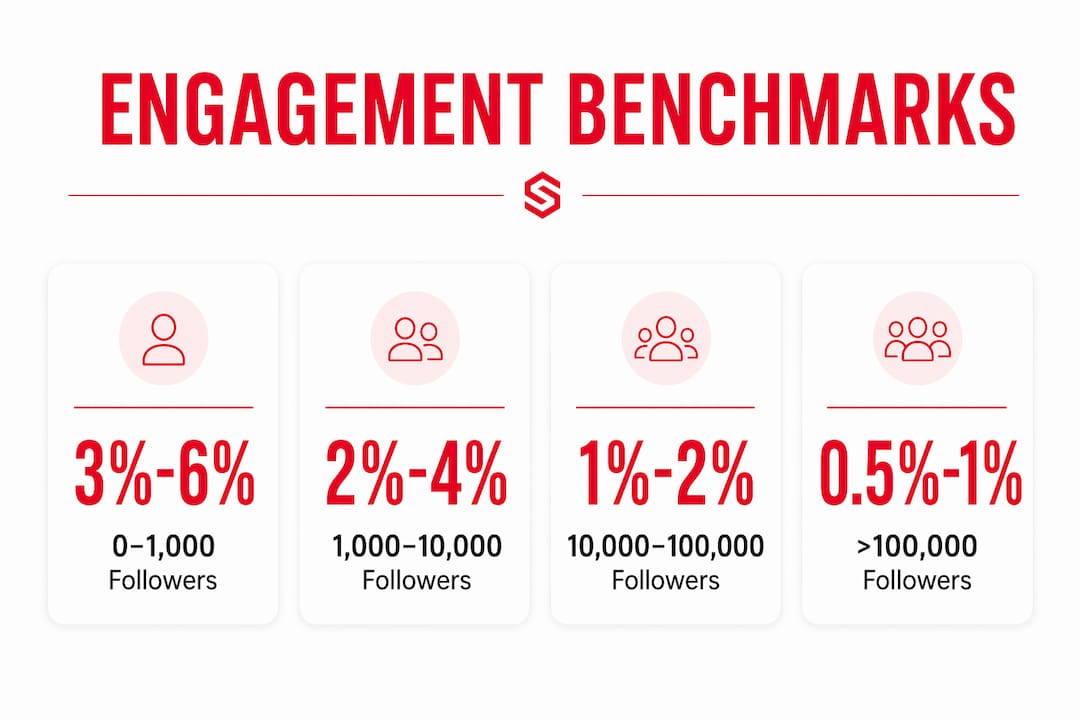
| Follower Count | Typical Engagement Rate |
|---|---|
| 0–1,000 | 3%–6% |
| 1,000–10,000 | 2%–4% |
| 10,000–100,000 | 1.5%–2.5% |
| 100,000–500,000 | 1%–1.5% |
| 500,000+ | 0.5%–1% |
These benchmarks matter because context changes everything. A 5% rate is normal for 500 followers but exceptional for 500,000 followers. A brand manager comparing their 100,000-follower account to a micro-influencer's 2,000-follower account will always look worse on paper, even if their content is performing well for their tier.
Niche also plays a significant role. Fitness, food, and parenting accounts tend to generate higher engagement than B2B or finance accounts. Benchmarking should always compare accounts of similar size and industry to produce a meaningful conclusion.
What nuances should marketers know when reading engagement data?
Engagement rate measures what researchers call "attention with intent." Impressions count every time a post appears on a screen. Engagement counts only when someone chose to act. High impressions but low engagement signals poor content alignment. The audience saw the post and kept scrolling.
This distinction is critical for content strategy. A post with 10,000 impressions and 50 likes tells you the content failed to connect. A post with 2,000 impressions and 200 likes tells you the content hit exactly the right nerve. Raw view counts flatter underperforming content.
Not all engagement actions carry equal weight. Likes are the lowest-commitment signal. Comments show active interest. Saves indicate the viewer found the content worth returning to. Shares extend your reach to new audiences. Saves and shares are the most valuable engagement actions, signaling to Instagram that the content has lasting value. The algorithm responds by distributing that content more widely.
The Instagram algorithm prioritizes interaction over follower count. Content triggering emotions like awe, recognition, or strong agreement encourages comments, saves, and shares. That emotional response creates a feedback loop: more engagement leads to broader distribution, which leads to more engagement.
- Likes: Low-commitment, easy to generate, least weighted by the algorithm
- Comments: Show active interest and conversation, strong algorithmic signal
- Saves: High-value signal indicating lasting content relevance
- Shares: Extend organic reach and introduce content to new audiences
Pro Tip: When auditing your content, sort posts by saves rather than likes. Save rate reveals which content your audience finds genuinely useful, not just momentarily entertaining.
How can marketers improve their Instagram engagement rate?
Improving engagement starts before you post. The strategy happens in content planning, not in the caption.
Nail the hook in the first 1.5 seconds. The first 1.5 seconds of a post determine whether a viewer keeps watching or scrolls past. A weak hook means only your most loyal followers engage, which skews your rate downward. For video, open with a bold visual or statement. For carousels, make the first slide impossible to ignore.
Create content that earns saves. Carousels and educational content get the highest save rates and better organic reach. Step-by-step guides, checklists, and data-driven posts give viewers a reason to save for later. One well-structured carousel can outperform five standard image posts on engagement.
Ask questions that demand a response. Captions that end with a direct question generate more comments than those that do not. The question should be specific and easy to answer. "What's your biggest challenge with Instagram right now?" outperforms "Let me know your thoughts."
Measure engagement over your last 10–15 posts, not just one. Single-post engagement rates fluctuate based on timing, topic, and algorithm distribution. A rolling average across recent posts gives you a stable baseline to work from and makes trends visible.
Test content variations systematically. Post the same core idea in two formats, such as a Reel versus a carousel, and compare reach-based engagement rates. Instagram's own analytics show which format your specific audience responds to. Use that data to guide your next content cycle.
Respond to every comment within the first hour. Early comment activity signals to the algorithm that the post is generating conversation. Responding quickly adds more comments to the count and increases the chance of broader distribution.
Key Takeaways
Instagram engagement rate is the most reliable measure of content quality because it counts deliberate audience actions, not passive views.
| Point | Details |
|---|---|
| Core definition | Engagement rate is the percentage of your audience that interacts via likes, comments, saves, and shares. |
| Best formula to use | Reach-based engagement rate is more accurate than follower-based for evaluating individual post performance. |
| Benchmark by account size | Rates of 3%–6% are normal for small accounts; mega-influencers typically see 0.5%–1%. |
| Saves outrank likes | Saves and shares carry more algorithmic weight than likes and signal lasting content value. |
| Hook determines outcome | The first 1.5 seconds of any post determine whether most viewers engage or scroll past. |
Why engagement rate tells you more than you think
Marketers consistently underestimate what engagement rate actually reveals. Most treat it as a vanity metric dressed up in math. It is not. It is a direct measure of whether your content earned someone's attention long enough to make them act.
The pattern I see most often is brands celebrating follower growth while their engagement rate quietly drops. An account growing from 10,000 to 50,000 followers sounds like success. But if engagement rate falls from 3.5% to 0.8% over the same period, the audience quality has deteriorated. Those new followers are not reading, saving, or sharing. They are just numbers.
The accounts that consistently outperform their size are the ones treating every post as a test. They check which content types earn saves. They track comment sentiment, not just comment count. They use reach-based metrics instead of follower-based ones because they want accuracy, not flattery.
AI-powered analytics tools have made this kind of granular tracking accessible to individual creators and small marketing teams, not just enterprise brands. The data is available. The mistake is ignoring it in favor of watching the follower counter go up.
— Zen
How Sogrow helps you turn engagement data into real growth
Understanding your engagement rate is only half the work. Acting on it consistently is where most marketers fall short.

Sogrow is an AI-powered Instagram growth platform built for marketers who want real results from real followers. Sogrow analyzes your engagement metrics to identify which content types, posting patterns, and audience segments drive the most meaningful interaction. Clients have reported growing from 2,000 to 18,000 followers and tripling their engagement rates within weeks. Fitness coaches and brands have used Sogrow to transform their Instagram accounts into active revenue channels. If you are ready to move beyond guesswork and build an audience that actually engages, Sogrow gives you the data and tools to make that happen.
FAQ
What does Instagram engagement rate mean exactly?
Instagram engagement rate is the percentage of your audience that takes a deliberate action on your content, including likes, comments, saves, and shares. It measures active interest, not passive views.
What is a good Instagram engagement rate in 2026?
An engagement rate between 1.5% and 2.5% is considered average in 2026. Accounts with fewer than 1,000 followers typically see rates of 3%–6%, while accounts over 500,000 followers average 0.5%–1%.
Which Instagram engagement formula is most accurate?
The reach-based formula divides total interactions by post reach rather than follower count. It is considered more accurate because it reflects how your content performed with everyone who actually saw it, not just your existing followers.
Why are saves more valuable than likes on Instagram?
Saves signal to the Instagram algorithm that content has lasting value, which increases its distribution. Likes are low-commitment actions, while saves indicate the viewer found the content worth returning to.
How often should I calculate my Instagram engagement rate?
Calculate your engagement rate as a rolling average across your last 10–15 posts. Single-post rates fluctuate too much to be reliable. A consistent average reveals real trends in your content performance.