
Paid vs Organic Instagram: Your 2026 Growth Guide
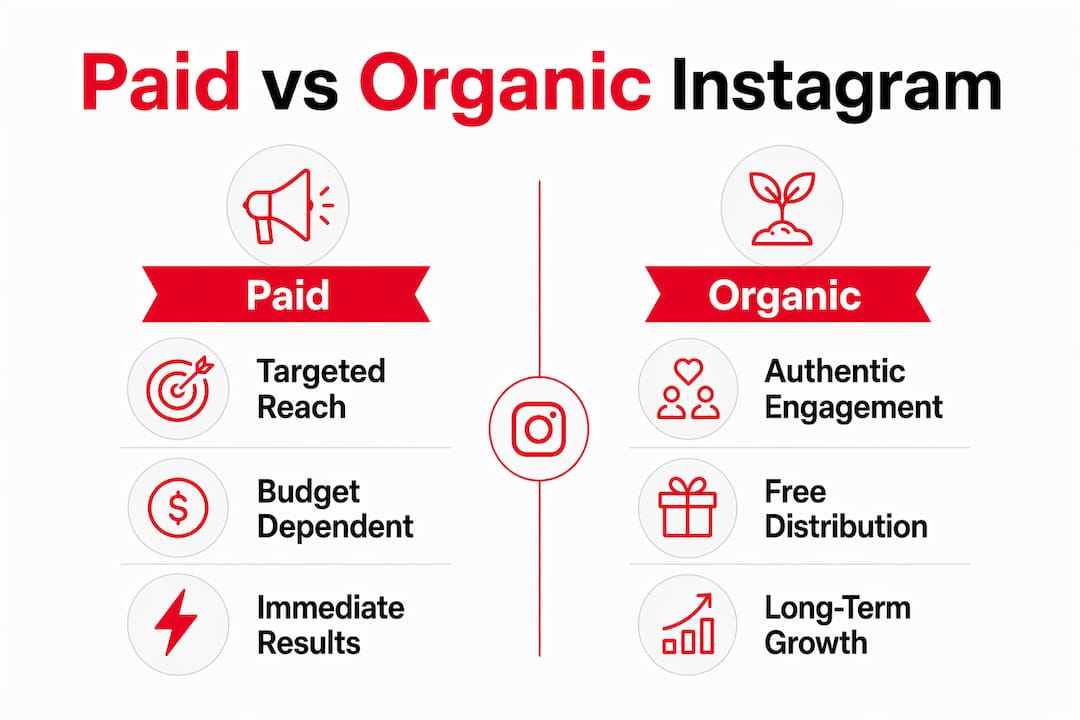
Paid Instagram content is defined as any post, Story, or Reel you pay to promote through Meta's ad system, with set budgets, audience targeting, and measurable delivery. Organic Instagram content, by contrast, reaches people naturally through the algorithm without direct payment. Understanding what is paid vs organic Instagram is not a theoretical exercise. Average organic reach for business accounts dropped to about 3.5% in early 2026, meaning fewer than 4 in 100 followers see any given post. That number makes the choice between paid and organic feel urgent. The reality is that both systems operate on completely different rules, and knowing those rules is the first step to building a strategy that actually works.
What is paid vs organic Instagram, and how do they differ?
Paid and organic Instagram content are distributed through two separate systems that do not influence each other. Paid reach is controlled entirely by your budget, targeting parameters, and campaign settings. The algorithm's organic signals, like saves or DM shares, have no effect on whether your ad gets shown. Organic content, on the other hand, lives or dies by engagement quality signals that Instagram's algorithm reads in real time.
The practical difference shows up immediately. A paid post reaches exactly the audience you define, on day one, at a cost per impression you can forecast. An organic post enters a testing queue where Instagram shows it to a small slice of your audience first, then expands distribution only if engagement signals are strong enough. That testing mechanic is why two accounts with identical follower counts can see wildly different reach numbers.

The industry terms you will encounter are "paid social" for the ad-driven side and "organic social" for the unpaid side. Both fall under the broader umbrella of Instagram marketing strategies, and both require distinct skill sets to execute well.
How does Instagram's algorithm treat paid and organic content differently?
Instagram's 2026 algorithm functions more as an interest-based recommendation engine than a follower-based feed. That shift has major consequences for organic content. Follower count matters far less than it did three years ago. What matters now is whether your content generates the engagement signals the algorithm weights most heavily.
The signals Instagram prioritizes for organic distribution include:
- DM shares: Sharing a post directly to another user's inbox is the highest-weighted signal in 2026. It signals that content is worth passing on.
- Saves: Saving a post tells the algorithm the content has lasting value, not just scroll-stopping appeal.
- Watch time: For Reels and video content, completing or rewatching a video signals strong relevance.
- Profile clicks: Clicking through to a profile after seeing a post indicates genuine interest beyond the content itself.
Likes still count, but they carry less weight than the signals above. DM shares weigh more than likes in Instagram's current ranking model. That means a post with 50 shares and 200 likes will outperform a post with 1,000 likes and no shares.
Paid content bypasses this entire system. Your ad budget determines delivery volume, and Meta's ad auction determines cost. The algorithm does not penalize your paid post for low organic engagement, and strong organic engagement does not give your paid post a discount. They are separate pipes.
Pro Tip: Post when your most engaged followers are online, then spend the first 30 minutes actively replying to every comment. Consistent community interaction in that window can boost organic reach by up to 40%.
What are the benefits and limitations of paid Instagram marketing?
Paid Instagram advertising gives you predictable, scalable reach from day one. You define the audience by interest, behavior, location, age, and lookalike profiles. You set the budget and the objective, whether that is link clicks, video views, or purchases. The result is measurable and repeatable in a way that organic content rarely is.
The clearest benefits of paid Instagram advertising are:
- Speed: A paid campaign reaches a new audience within hours of launch, not weeks.
- Targeting precision: You can reach people who have never heard of your brand but match your exact customer profile.
- Measurable conversions: Meta's ad platform tracks cost per click, cost per purchase, and return on ad spend with enough granularity to make budget decisions confidently.
- Creative testing at scale: Running A/B tests on paid ads gives you statistically meaningful data faster than organic testing alone.
The limitations are real, though. Recommended monthly budgets for a single platform range from roughly $1,600 to $3,200 per month to generate actionable data. Below that threshold, your sample sizes are too small to draw reliable conclusions. Paid also stops the moment you stop spending. There is no compounding asset. Every dollar buys reach only for as long as the campaign runs.
Pro Tip: Never run paid ads on content you have not already tested organically. Spending budget on an unproven creative is the most common and most expensive mistake in paid Instagram marketing.
The other common pitfall is skipping the creative validation step entirely. Businesses that jump straight to paid without organic testing often burn through budget on messaging that does not resonate, then conclude that paid Instagram does not work for them. The problem is almost never the platform. It is the creative.
What are the benefits and limitations of organic Instagram marketing?
Organic Instagram content builds something paid ads cannot: a content library that keeps working without ongoing spend. Every Reel, carousel, or Story you post becomes a permanent asset. Strong organic content compounds over time as it gets shared, saved, and surfaced to new audiences through Instagram's recommendation system.
The core benefits of organic content are:
- Brand trust: Audiences who find you organically tend to be more engaged and more loyal than those acquired through ads.
- Community depth: Organic content creates space for real conversation. Comments, DMs, and replies build relationships that convert over time.
- Content ownership: Unlike paid reach, which disappears when your budget runs out, organic posts remain on your profile indefinitely.
- Algorithm rewards: When organic content performs well, Instagram surfaces it to non-followers through Explore, Reels feeds, and hashtag results at no cost.
The limitations are equally real. Organic reach has declined by about 12% year over year, and accounts with over 10,000 followers often reach under 1% of their audience with a single post. Organic growth is slower, less predictable, and increasingly dependent on Reels and short video formats that require more production effort than static posts.
Pro Tip: Shift your organic content mix toward Reels if you have not already. Instagram's algorithm currently gives Reels the widest organic distribution of any content format on the platform.
Organic also requires consistency. Posting sporadically signals low relevance to the algorithm. A content calendar with at least three to five posts per week, combined with daily Story activity, gives the algorithm enough data to understand your account and expand your reach.
How can businesses integrate paid and organic Instagram strategies?
The most effective Instagram marketing approach treats organic and paid as a single system, not two competing options. Businesses combining paid and organic social efforts generate more revenue than those relying on either channel alone. The reason is structural: organic builds the creative assets and audience trust that make paid ads more efficient.
The organic-first testing framework
An organic-first strategy means spending 60 to 90 days posting consistently before allocating significant paid budget. During that period, you identify which content formats, topics, and hooks generate the highest saves, shares, and watch time. Those top performers become your paid ad creatives. You are not guessing at what will work. You have data.
This approach prevents the most expensive mistake in Instagram marketing: running paid spend on creative that has never been validated. Most businesses that succeed with paid Instagram use organic testing to surface their best content before amplifying it.
Practical integration principles
Once you have validated content, the integration looks like this:
- Use organic posting to maintain brand presence, nurture your existing audience, and test new creative concepts continuously.
- Use paid amplification to scale the content that already performs, reach new audiences, and drive specific conversion objectives.
- Treat the PACE framework approach, which prioritizes performance testing and consistency, as your operating system rather than a one-time campaign tactic.
- Revisit your top-performing organic posts monthly and consider boosting any that show strong save and share rates.
The false choice between organic and paid wastes time and money. The real shift is from "organic vs. paid" to "organic plus paid," where organic builds creative assets and paid amplifies the ones that work.
Key Takeaways
Paid and organic Instagram strategies work best as a unified system: organic validates content and builds trust, while paid scales what already works.
| Point | Details |
|---|---|
| Organic reach is declining | Average business account reach dropped to 3.5% in 2026, making strategy more critical than ever. |
| Algorithm signals differ | DM shares and saves drive organic reach; paid reach is controlled entirely by budget and targeting. |
| Paid requires validated creative | Run organic content for 60–90 days before spending paid budget to avoid wasting money on unproven posts. |
| Organic builds lasting assets | Organic posts compound over time; paid reach stops the moment your budget runs out. |
| Integration beats either alone | Businesses using both paid and organic together generate more revenue than those relying on one channel. |
What I have learned from watching the organic-plus-paid shift up close
The conversation I hear most often from business owners is some version of "organic is dead, so we are going all-in on paid." That framing is wrong, and it is expensive to be wrong about it.
Organic reach has declined, but that does not mean organic content has lost its value. What it means is that the bar for organic content has risen. The algorithm now rewards content that earns genuine reactions, specifically DM shares and saves, over content that simply looks polished. I have watched accounts with 2,000 followers outperform accounts with 50,000 followers because they built a tight, engaged community that shared their content consistently.
The shift from follower count to engagement quality is the most important change in Instagram marketing in the past three years. Accounts that treat their comment sections as a community, not a broadcast channel, are the ones the algorithm keeps rewarding with more reach. That flywheel is the whole point.
My honest recommendation: do not allocate serious paid budget until you have at least 8 to 12 pieces of organic content with strong save and share rates. Those posts tell you exactly what your audience values. Paid amplification of that content will outperform any ad built from scratch, every time. The data does not lie, and neither does your audience's behavior.
— Zen
How Sogrow fits into your Instagram growth system
Building a consistent organic content practice while managing paid campaigns is genuinely difficult to do without the right tools. Sogrow is an AI-powered platform built specifically for this challenge.
Sogrow analyzes your content performance in real time, surfaces which posts are generating the saves and shares that matter to the algorithm, and helps you identify your best organic content before you put paid budget behind it. Clients have grown from 2,000 to 18,000 followers and tripled their engagement rates within weeks by following the organic-first system Sogrow supports. If you are ready to build an Instagram presence that compounds, start with Sogrow and let the data guide every decision.
FAQ
What is the main difference between paid and organic Instagram?
Paid Instagram content reaches audiences through Meta's ad system using a set budget and targeting. Organic content reaches audiences through Instagram's algorithm based on engagement quality signals like saves and DM shares.
Does paid Instagram advertising affect organic reach?
Paid ads do not boost organic reach. The two systems operate independently. Running a paid campaign does not signal anything to Instagram's organic algorithm.
How long should I test content organically before running paid ads?
An organic-first testing period of 60 to 90 days gives you enough data to identify top-performing content before committing paid budget. This prevents spending on creative that has not been validated.
What engagement signals matter most for organic reach on Instagram in 2026?
DM shares, saves, and watch time are the highest-weighted signals for organic distribution. Likes still count but carry less algorithmic weight than shares and saves.
Is paid Instagram worth it for small businesses?
Paid Instagram delivers measurable results when you have validated creative and a sufficient budget. Budgets below roughly $1,600 per month on a single platform often generate sample sizes too small to draw reliable conclusions.