
Instagram CTA Strategies to Convert Followers into Clients
A well-optimized Instagram CTA converts followers into paying clients by triggering immediate, automated engagement that qualifies leads before a single sales call happens. The term "call-to-action" covers everything from a comment keyword on a feed post to a swipe-up link in Stories, but not all CTAs carry equal weight. Converting followers into customers requires matching the right CTA type to the right content format and audience intent stage. Data from 373,000 DM conversations shows that optimized DM funnels convert 15 to 35% of qualified leads into clients. That number makes Instagram one of the most efficient lead generation channels available to social media managers and business owners today.
What makes an Instagram CTA effective for client conversion?
An effective Instagram CTA is a single, specific instruction that removes friction and delivers immediate value. The research is clear: multiple CTAs per post cut conversion rates in half. One post, one goal. That rule alone separates accounts that generate clients from accounts that generate likes.
Keyword-triggered CTAs outperform generic "link in bio" instructions by 2 to 5x. When you ask someone to "Comment GUIDE below," two things happen simultaneously. The comment triggers an instant DM from your automation, and that comment registers as an engagement signal Instagram's algorithm weights 10x more than a like. You get a lead and a reach boost from the same action. Tools like ManyChat and SetSmart are built specifically to handle this trigger-to-DM flow at scale.

Matching CTA type to content format matters more than most creators realize. Use "Save this" on Reels that teach a framework. Use "Comment [keyword]" on feed posts where you want to start a DM conversation. Use "Tap the link" on Stories with a direct booking or lead magnet link. Each format has a different user behavior pattern, and your CTA should work with that pattern rather than against it.
Specific, memorable trigger keywords like GUIDE, BOOK, CHECKLIST, or FREE convert better than vague instructions like "DM me for more info." The specificity signals value before the user even takes action. It tells them exactly what they will receive.
- Use one CTA per post, always.
- Choose trigger keywords that describe the outcome, not the action (GUIDE beats "message me").
- Match CTA format to content type: "Save" for Reels, "Comment" for feed, "Tap" for Stories.
- Avoid soft CTAs like "let me know your thoughts" on posts designed to generate leads.
- Rewrite AI-generated hooks and CTAs manually. AI-drafted captions are useful starting points, but the hook and CTA need your authentic voice to convert.
Pro Tip: Test two trigger keywords on the same post type over two weeks. The keyword with the higher comment rate becomes your default for that content format.
Which tools and automation strategies convert followers into qualified leads?
Instagram lead generation at scale requires a structured funnel, not just a clever caption. The four stages of a working DM funnel are trigger, capture, qualify, and book. Each stage has a specific job, and skipping one collapses the conversion rate.
Meta API-based platforms like SetSmart, ManyChat, and ReplyRush handle the trigger-to-DM delivery automatically. When a follower comments your keyword, the platform sends a pre-written DM within seconds. That speed matters. Accounts replying within 5 seconds outperform large follower accounts that respond hours later, regardless of audience size. Responding within 2 hours increases conversion rates by 60%.
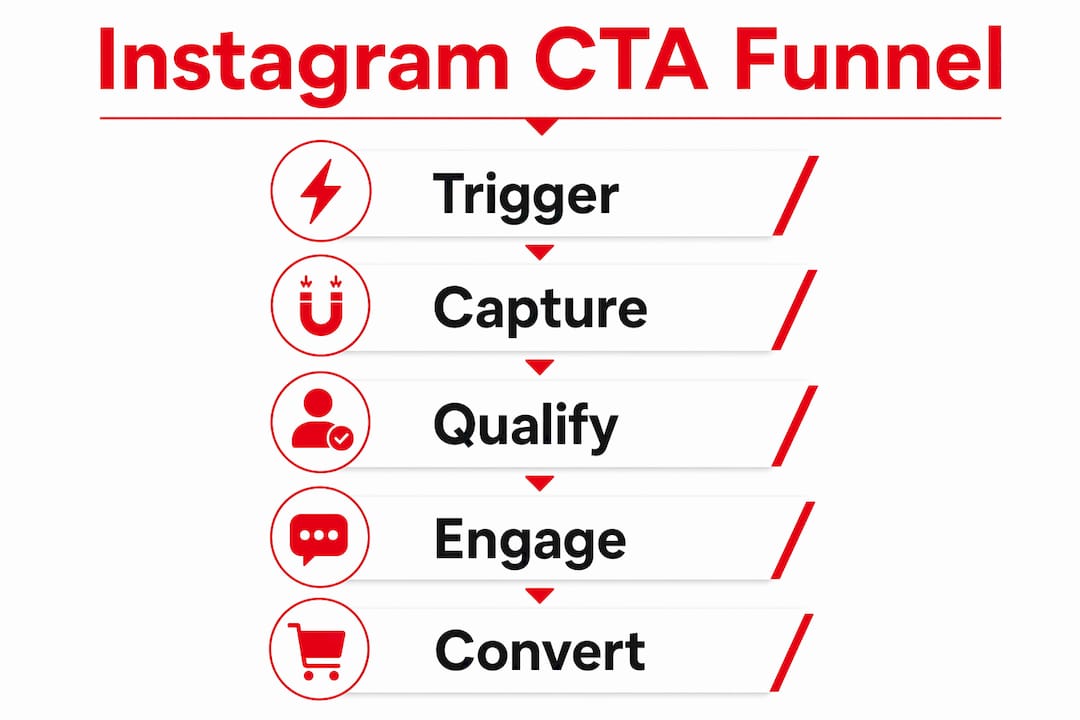
The capture stage delivers your lead magnet, a free guide, checklist, or mini-training, inside the DM. DM automation delivering lead magnets achieves a 40 to 80% contact information capture rate compared to generic messaging. For accounts with 10K to 20K followers posting 3 to 4 times weekly, that translates to 120 to 720 new email subscribers per month.
The qualify stage is where most accounts lose money by skipping it. Automation should ask 2 to 3 short questions before routing anyone to a booking link. Questions like "What's your biggest challenge with X right now?" and "Are you currently working with a coach?" separate high-fit leads from browsers. This protects your calendar and prevents burnout for coaches and founders managing volume alone.
| Funnel stage | Tool function | Benchmark |
|---|---|---|
| Trigger | Keyword comment activates DM | Instant delivery via ManyChat or SetSmart |
| Capture | Lead magnet delivered in DM | 40 to 80% contact capture rate |
| Qualify | 2 to 3 branching questions asked | 22.9% of openers qualify |
| Book | Calendly or booking link sent | 14.75% of qualifiers book calls |
Branching logic inside platforms like ManyChat routes high-fit leads directly to a booking link and places low-fit leads into a nurture sequence. This means your automation handles volume while you focus only on conversations that are already pre-qualified.
Pro Tip: Set up a follow-up sequence at 4 hours and 23 hours after initial DM contact. Following up at these intervals nearly triples qualification rates from Instagram leads.
How to design content and CTAs that support your conversion funnel
Content design and CTA placement work together as a system. A strong post that ends with a weak CTA wastes the attention you earned. Structure every caption using four layers: Hook, Context, Insight, CTA. The hook stops the scroll. Context establishes why this matters. The insight delivers the value. The CTA captures the lead.
Interactive Stories are the most underused lead generation format on Instagram. Polls, questions, and countdown stickers combined with direct links capture 3 to 7x more leads than feed posts alone. That multiplier exists because Stories create a two-way interaction that feels personal rather than broadcast.
Here is a practical content and CTA sequence for a 30-day conversion campaign:
- Post 3 to 4 feed posts per week with keyword-triggered CTAs. Each post targets one specific pain point your ideal client experiences.
- Run 3 to 5 Stories daily during the campaign. Use polls on days 1 and 2 to segment your audience by interest. Use question stickers on days 3 and 4 to surface objections. Use countdown stickers on day 5 to create urgency around a free resource or call.
- Match CTA intensity to audience temperature. Use soft CTAs like "Save this for later" or "Comment your biggest question" for cold audiences discovering you through Reels. Use direct booking CTAs for warm audiences who have engaged with 3 or more posts.
- Never place a booking link CTA on a Reel. Reels reach cold audiences who have no relationship with you yet. A booking CTA on cold traffic produces drop-off and signals desperation.
- Use your comment keyword consistently across posts in the same campaign so your audience starts to recognize it as a pattern.
- Review Stories engagement data every 7 days. If poll participation drops below 10%, rotate the topic or format before audience fatigue sets in.
- At the end of each week, identify which post generated the most keyword comments and replicate its structure in the following week.
Tailoring CTAs to audience stage is the difference between Instagram as a branding tool and Instagram as a prospecting database. Treat it like a database and your content decisions become much more deliberate.
Common mistakes that kill your Instagram CTA conversion rate
The most expensive mistake in Instagram conversion funnels is offering a booking link too early in the DM conversation. Booking conversion rates drop to 0.07 to 2% when the link appears before the 11th message. That same conversion improves to 11.25% when the booking offer arrives between messages 11 and 20. The difference is trust. You have not earned the ask yet.
Here are the mistakes that consistently destroy conversion rates:
- Multiple CTAs per post. Asking followers to "save, comment, and DM" in the same post cuts conversion by 50%. Pick one.
- Generic automated DMs. Messages that read like a bot reduce reply rates by 40 to 60%. Personalize the opening line with the commenter's name and the specific keyword they used.
- Slow manual responses. If you are not using automation, a response delay of more than 2 hours decreases your conversion rate by 60%.
- No follow-up sequence. Failing to follow up at 4 and 23 hours loses more than half of all conversations that could have converted.
- Off-platform redirects too early. Sending someone to a website or Google Form in the first 3 messages increases drop-off significantly. Keep the conversation inside Instagram until trust is established.
- Mismatched CTA and content intent. A post about mindset that ends with "Book a strategy call" creates cognitive dissonance. The CTA must feel like the natural next step from the content.
"The accounts that convert best are not the ones with the most followers. They are the ones with the tightest funnels and the most relevant CTAs for where their audience is in the buying process." — SetSmart, Instagram Lead Generation: Real Funnel Data 2026
Fixing these mistakes does not require more content. It requires more precision in the content you already produce.
Key takeaways
Effective Instagram CTAs convert followers into clients by combining keyword-triggered automation, funnel-stage-matched content, and disciplined follow-up sequences that qualify leads before any booking offer is made.
| Point | Details |
|---|---|
| One CTA per post | Multiple CTAs cut conversion rates by 50%; one focused ask always outperforms. |
| Keyword triggers beat "link in bio" | Comment-triggered CTAs convert 2 to 5x better and boost algorithmic reach simultaneously. |
| Qualify before booking | Booking links sent before message 11 convert at under 2%; the 11 to 20 message window hits 11.25%. |
| Stories multiply lead capture | Interactive Stories with polls and questions generate 3 to 7x more leads than feed posts alone. |
| Follow-up timing is non-negotiable | Following up at 4 and 23 hours nearly triples qualification rates from initial DM contact. |
What I've learned about Instagram conversion after watching thousands of funnels
Most accounts treat their Instagram CTA as an afterthought. They spend 90% of their energy on the visual and the caption, then tack on "DM me to learn more" at the end. That approach produces engagement, not revenue.
What actually works is building the CTA first and writing the content backward from it. Decide what action you want the follower to take, then create content that makes that action feel obvious. This is a mindset shift that most social media managers resist because it feels too sales-focused. It is not. It is just honest about what the post is for.
Automation is not a shortcut. It is a qualification layer. The accounts I have seen scale from a few clients per month to a full calendar are not posting more. They are using tools like ManyChat or SetSmart to handle the volume of conversations that a human cannot manage at 11pm on a Tuesday. The human touch comes in at the booking call, not the first DM.
The Instagram algorithm in 2026 favors DM shares and comment engagement over passive likes. That means every keyword-triggered CTA you run is simultaneously a conversion tool and a reach amplifier. The two goals are no longer in conflict. They reinforce each other when your CTA is designed correctly.
Test relentlessly. The keyword that converts for a fitness coach will not convert for a B2B consultant. Your audience has its own language, and your job is to find it through iteration, not assumption.
— Zen
Grow your Instagram following and convert it with Sogrow
Building a high-converting Instagram funnel starts with having the right followers in the first place. Sogrow uses AI-powered growth to attract real, engaged followers who are genuinely interested in your content, not inflated vanity metrics. Fitness coaches using Sogrow have grown from 2K to 18K followers while tripling their engagement rates, creating the exact audience conditions where keyword-triggered CTAs and DM funnels produce consistent client bookings. If you are running conversion campaigns on a small or disengaged audience, even the best CTA strategy will underperform. Start building the foundation that makes your funnel work. Try Sogrow and see what AI-driven organic growth does for your conversion rates.
FAQ
What is a keyword-triggered CTA on Instagram?
A keyword-triggered CTA asks followers to comment a specific word, like GUIDE or BOOK, which automatically sends them a DM via platforms like ManyChat or SetSmart. This method converts 2 to 5x better than directing followers to a link in bio.
How many CTAs should I use per Instagram post?
Use exactly one CTA per post. Research shows that multiple CTAs per post cut conversion rates in half, so every post should have a single, focused ask.
When should I send a booking link in a DM funnel?
Send the booking link between messages 11 and 20 in the DM conversation. Booking conversion rates drop to under 2% when the link appears too early, but reach 11.25% in the 11 to 20 message window.
Do Instagram Stories generate more leads than feed posts?
Yes. Interactive Stories using polls, questions, and countdown stickers capture 3 to 7x more leads than feed posts alone, according to data from Monolit's 2026 lead generation research.
How fast do I need to respond to Instagram DMs to convert leads?
Speed is the strongest predictor of conversion. Accounts that respond within 5 seconds outperform larger accounts that reply hours later, and responding within 2 hours increases conversion rates by 60%.