Instagram Collab Posts: Your Growth Strategy Guide
Instagram collab posts are co-authored content that appears simultaneously on two or more profiles, pooling all engagement metrics into a single unified signal that tells the algorithm to distribute the content more widely. The role of Instagram collab posts in growth is structural, not incidental. When you combine audiences, you combine reach, saves, comments, and shares into one thread that carries far more algorithmic weight than any solo post. Platforms like Buffer and Later have documented this effect, and Shopify data confirms that collab posts generate more than double the impressions of standard organic content. For social media managers running lean teams and tight budgets, that multiplier is one of the most efficient organic growth tactics available on Instagram today.
How Instagram collab posts amplify reach and engagement
The core mechanic behind Instagram collab posts is deceptively simple. When two accounts co-author a post, every like, comment, save, and share flows into one engagement thread rather than splitting across separate posts. That pooled engagement signal tells Instagram's algorithm that the content is performing strongly, which triggers broader distribution on the Explore page and in Reels feeds.
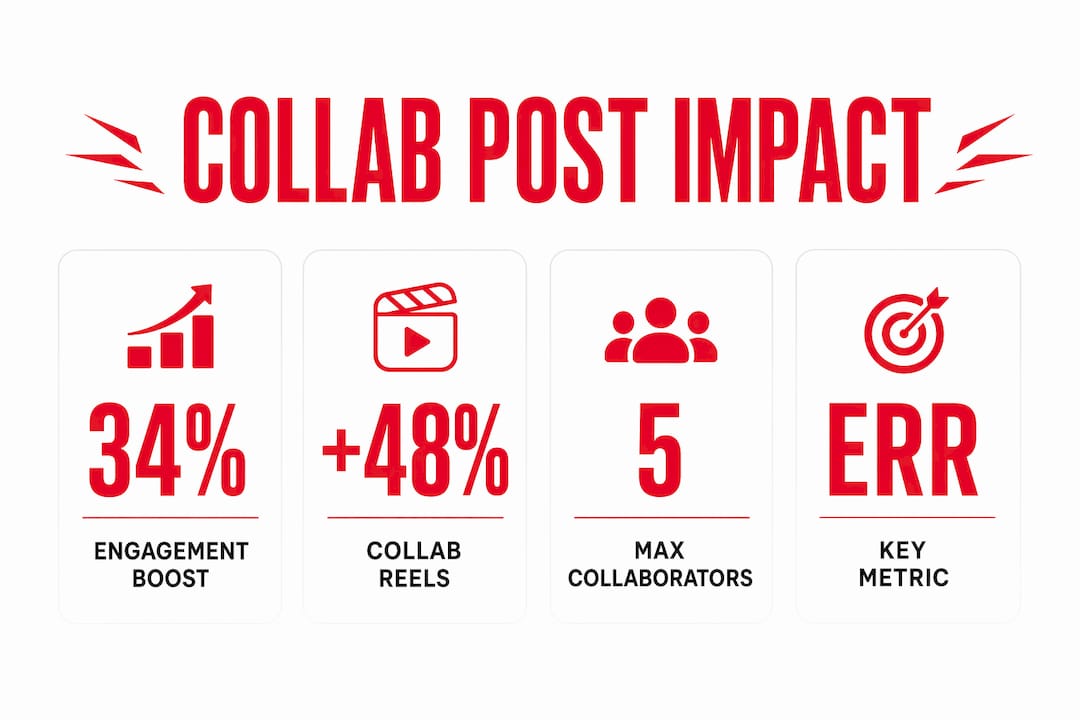
Format matters significantly here. Collab Reels outperform static collab posts, with collab Reels averaging +48% engagement uplift compared to solo posts, while standard collab posts average +34%. The implication is clear: if you are choosing between formats for a collaboration, Reels give you the strongest algorithmic push. Carousels also perform well because they generate multiple interactions per viewer, which further strengthens the engagement signal.

Instagram allows up to five collaborators on a single post, which means the distribution potential multiplies with each additional profile. A post appearing on five relevant accounts simultaneously does not just reach five audiences. It generates five independent streams of early engagement that feed back into one unified metric set.
One tactical detail that most managers overlook: the account with the larger following should initiate the collab. Adam Mosseri has confirmed that early distribution advantages favor the account with the broader existing reach, which gives the content a stronger initial push before the algorithm decides how widely to distribute it.
Pro Tip: Measure collab performance using Engagement Rate by Reach (ERR), not raw likes or comments. Calculate ERR as total engagements divided by reach. This removes the inflation caused by distributing content across multiple audiences and gives you a true read on content quality.
How to choose the right collaborators for maximum growth
Partner selection is where most Instagram growth strategies fall apart. The instinct is to chase follower counts, but overlapping yet distinct audiences produce stronger organic growth than partnerships based on size alone. A fitness coach with 15,000 highly engaged followers in your niche will outperform a lifestyle account with 200,000 passive followers every time.
The criteria that actually predict collab success are:
- Audience relevance: Your collaborator's followers should have a genuine reason to care about your content, not just your collaborator's content.
- Content slot fit: The post must look and feel natural on both feeds. If it reads as an ad on one profile, the other profile's audience will disengage.
- Engagement quality: Check your potential partner's recent posts. A consistent comment-to-follower ratio above 1% signals an active, real audience.
- Niche differentiation: The best collabs connect adjacent niches, such as a nutritionist partnering with a meal prep brand, rather than two accounts doing identical content.
Use follower overlap analysis tools to quantify how much your audiences already share. If overlap is above 60%, the collab adds less incremental reach. If overlap is below 20%, the audiences may be too different to convert. The sweet spot sits between 25% and 50% overlap, where you reach genuinely new people who still have contextual reasons to follow you.
Pro Tip: Before launching a collab, align on a single shared message in writing. Mismatched captions or conflicting calls to action confuse both audiences and dilute the growth impact. A one-paragraph brief shared between collaborators takes ten minutes and prevents weeks of underperformance.
Micro-influencer partnerships deserve specific attention here. Smaller, highly engaged collaborators consistently outperform larger accounts with superficial followings when the content fits naturally on both feeds. For brands working with Instagram influencer partnerships, this means prioritizing engagement history over reach estimates.
How to measure the impact of collab posts on your growth
Measurement is where the effectiveness of joint posts on Instagram either gets confirmed or gets lost in noise. The challenge is that pooled metrics inflate raw numbers, making a collab post look better than it actually performed relative to your solo content. The fix is normalization and comparison.
| Metric | What it measures | How to use it |
|---|---|---|
| Reach | Total unique accounts that saw the post | Compare to your solo post baseline on the same format |
| ERR (Engagement Rate by Reach) | Engagement quality relative to distribution | Target above your solo post ERR to confirm content resonance |
| Saves | Depth of audience interest | High saves signal content worth repeating with the same collaborator |
| Follower delta | Net new followers gained post-collab | Track 24h and 72h windows separately to catch delayed growth |
| Impressions vs. reach gap | How often the same person saw the post | A large gap suggests algorithmic re-distribution, which is a positive signal |
Track performance at 24 and 72 hours after posting. The 24-hour window captures the initial algorithmic push. The 72-hour window reveals whether the content has legs, meaning whether saves and shares are continuing to drive distribution after the initial spike fades.
The most reliable measurement framework is a clean A/B comparison. Run a collab post and a solo post in the same format within the same week, then compare ERR, saves, and follower delta. This approach, recommended by data-driven collab analysis, removes seasonal and algorithmic noise and gives you a direct read on incremental lift.
Avoid reporting on raw likes or comments in isolation. Distribution inflation means a collab post will almost always show higher raw numbers than a solo post, but that does not confirm the content resonated. Reach breakdowns and follower growth are the metrics that accurately assess collaboration impact over time.
Creative content formats that drive collab post engagement
The most effective collab content formats share one characteristic: they give both audiences a clear reason to engage rather than just observe. Here are the formats that consistently deliver results:
- Joint Reels with a shared narrative. Two creators each film their half of a story, tutorial, or challenge. The format works because it creates natural curiosity and rewards viewers who follow both accounts.
- Collaborative giveaways. Both accounts promote a prize that is relevant to both audiences. Require followers to follow both accounts and tag a friend to enter. This is one of the fastest follower acquisition tactics available through collabs.
- Co-created carousels. Each slide alternates between the two brands or creators, showcasing complementary perspectives on a shared topic. Nutritionists and fitness coaches use this format effectively.
- User-generated content suites. Invite your community to create content around a shared campaign hashtag, then feature the best submissions as a collab post with a partner brand. This multiplies content volume while deepening community investment.
- Multi-brand product launches. Two complementary brands launch a limited product or bundle simultaneously, using a collab post as the announcement. Diverse formats timed around key events consistently outperform evergreen collab content.
Scheduling matters as much as format. Use planning tools like Later or a content calendar built into your social media management platform to align posting times with peak audience activity on both accounts. When both audiences are most active simultaneously, the early engagement signal is stronger, which accelerates algorithmic distribution.
For teams managing multiple collabs at once, AI-powered content calendars reduce the coordination overhead significantly. You can learn more about growing on Instagram through structured content planning that accounts for collab timing and format mix.
Key takeaways
Instagram collab posts drive organic growth by pooling engagement metrics across multiple profiles, giving the algorithm a stronger signal to distribute content more widely than any solo post can achieve.
| Point | Details |
|---|---|
| Pooled metrics drive reach | Likes, saves, and comments combine into one signal, triggering broader algorithmic distribution. |
| Reels outperform static collabs | Collab Reels average +48% engagement uplift versus solo posts, making them the priority format. |
| Partner fit beats follower count | Overlapping yet distinct audiences produce stronger growth than partnerships based on size alone. |
| ERR is the right measurement | Divide total engagements by reach to normalize for distribution inflation across multiple audiences. |
| Track 24h and 72h windows | Separate time windows reveal both initial push performance and sustained content resonance. |
Why I think most teams are measuring collabs wrong
Most social media managers I have seen evaluate collab posts the same way they evaluate solo posts: total likes, total comments, and whether follower count went up. That approach misses the entire point of what collabs do structurally.
Collabs are reach multipliers, not magic bullets. The value is in the incremental reach you would not have gotten otherwise, and in whether that new reach converted into followers who actually stay. Raw engagement numbers will almost always look better on a collab post simply because more people saw it. That does not mean the content was better. It means the distribution was wider.
The teams that get real, compounding value from collaboration marketing on Instagram are the ones who treat every collab as a data point. They track ERR against their solo baseline, they note which collaborator's audience converted at a higher rate, and they use that data to refine the next partnership. The measurement challenges from pooled metrics are real, but they are solvable with the right normalization approach.
My honest observation after watching dozens of brand accounts run collab campaigns: audience fit is the single variable that separates accounts that grow sustainably from accounts that spike and plateau. A collab with a perfectly aligned micro-creator will outperform a collab with a celebrity account in the wrong niche, every single time. Stop chasing reach and start chasing relevance.
— Zen
How Sogrow helps you execute and measure Instagram collabs

Sogrow's AI-powered platform is built for exactly the kind of data-driven collab strategy this article describes. The platform's ideas generator helps you craft collab content that fits naturally on both feeds, while integrated scheduling workflows handle multi-account coordination without the back-and-forth. Advanced analytics track ERR, reach, saves, and follower delta across your collab posts, so you always know which partnerships are driving real growth versus inflated vanity numbers. Fitness coaches and brand accounts have used Sogrow to scale from 2K to 18K followers and triple engagement rates within weeks. If you are ready to turn Instagram collab posts into a measurable growth channel, start with Sogrow today.
FAQ
What are Instagram collab posts?
Instagram collab posts are co-authored content that appears on two or more profiles simultaneously, with all engagement metrics pooled into a single thread. Instagram supports up to five collaborators on one post.
How do collab posts boost engagement?
Collab posts pool likes, comments, saves, and shares into one unified metric set, creating a stronger algorithmic signal that drives broader distribution on Explore and Reels feeds.
What engagement increase can I expect from collab posts?
Collab posts average a +34% engagement increase over solo posts, while collab Reels average +48% uplift, based on Later benchmark data.
How should I measure Instagram collab post performance?
Use Engagement Rate by Reach (ERR), calculated as total engagements divided by reach, and track follower delta at both 24 and 72 hours post-publish to separate distribution volume from genuine content resonance.
Does collaborator follower count matter more than audience fit?
Audience fit matters more. Accounts with overlapping yet distinct audiences produce stronger organic growth than partnerships chosen by follower count alone, particularly when the content fits naturally on both feeds.