
Instagram Call to Action: Your 2026 Guide to More Conversions
An Instagram call to action (CTA) is a direct prompt that tells your audience exactly what to do next, whether that means saving a post, clicking a link, or sending a DM. In marketing, the term "CTA" refers to any instruction designed to move a passive viewer toward a specific, measurable action. On Instagram, where content competes for attention across Reels, Stories, and carousels, a well-placed CTA is the difference between a scroll and a conversion. Understanding what an Instagram call to action is, and how to use it well, is the foundation of any serious Instagram marketing strategy in 2026.
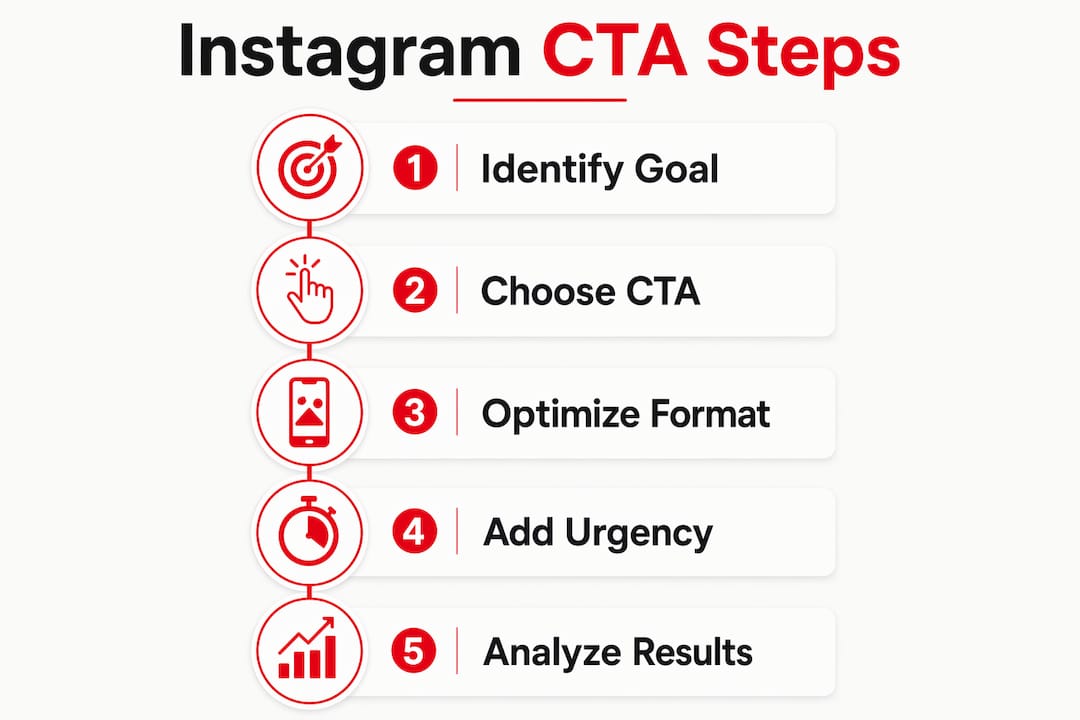
What is an Instagram call to action and why does it matter?
An Instagram CTA is a specific prompt designed to convert passive viewers into engaged users by directing them toward a desired action, such as commenting, sharing, saving, or clicking a link. The goal is not just to get attention. It is to channel that attention into a result you can measure.
CTAs have evolved significantly. Early Instagram marketing relied on simple phrases like "link in bio." Today, optimized link-in-bio setups achieve 3–5% click-through rates, and DM automation delivers the highest return on investment of any Instagram tactic. That shift reflects a broader truth: the platform rewards accounts that generate meaningful interactions, not just impressions.
The Instagram algorithm is interest-based. It classifies and amplifies content based on the engagement signals it receives over weeks. CTAs act as those signals. When your audience saves, shares, or replies to your content, the algorithm reads that as a quality indicator and distributes your posts to a wider audience. A CTA is not just a marketing phrase. It is a signal to the platform itself.
What are the main types of Instagram CTAs?
Four primary CTA categories define most Instagram marketing strategies: Save, Click, Buy, and Share. Each serves a different business goal and works best at a different stage of the audience relationship.
| CTA Type | Primary Goal | Best Used When |
|---|---|---|
| Save | Signal content value to the algorithm | Sharing educational or reference content |
| Click | Drive traffic to a landing page or offer | Promoting a product, blog post, or event |
| Buy | Direct sales conversion | Warm audiences already familiar with your brand |
| Share | Expand organic reach to new audiences | Publishing relatable or viral-style content |
The distinction between soft and hard CTAs matters here. A soft CTA asks for a low-commitment action, such as "Save this for later" or "Drop a if this helped you." A hard CTA asks for a bigger step, like "Click the link to buy now." Soft CTAs work well with cold audiences who do not yet trust your brand. Hard CTAs perform better with warm audiences who have already engaged with your content multiple times.

Saves and shares carry higher algorithmic value than likes. Creators who use save CTAs on educational content consistently see wider organic distribution. That means a well-timed "Save this post" is not just a request. It is a growth mechanism.
How does content format affect CTA performance?
The format of your post determines where and how your CTA lands. Reels drive discovery, carousels drive saves, and Stories drive daily engagement. Each format has a natural CTA placement that outperforms caption-only approaches.
High-performing accounts post 3–5 feed posts weekly plus 5–7 Stories daily. That frequency is not arbitrary. It creates enough touchpoints to move an audience from cold to warm, which is when harder CTAs start to convert.
Placement within a format matters just as much as the format itself. Placing CTAs on-screen during the final seconds of Reels and on the last slide of carousels significantly improves action rates compared to burying the prompt in a caption. Stories have a specific safe zone: the lower-middle area of the screen avoids the profile icon at the top and the reply bar at the bottom.
Common mistakes that kill CTA performance include:
- Using "link in bio" with no context about what the link leads to
- Placing the CTA in the first caption line before the "more" cutoff, where it gets ignored
- Adding a CTA to every single post without varying the ask, which trains your audience to tune it out
- Skipping on-screen text CTAs in Reels and relying only on the caption
Pro Tip: On carousels, treat the final slide as a dedicated CTA card. Use a single line of text, a clear instruction, and a visual that contrasts with the rest of the post. This slide gets seen by the most engaged viewers, making it your highest-value CTA placement.
What makes an Instagram CTA actually convert in 2026?
The most effective Instagram CTAs in 2026 do not command. They offer. The shift from "Click here" to "Grab your free checklist" reflects a fundamental change in how audiences respond to prompts. Frictionless CTAs with minimal cognitive load consistently outperform instructions that require multiple steps or decisions.
One clear CTA per post is the rule. Overloading a post with multiple asks lowers conversion because it forces the viewer to choose. When someone has to decide between saving, sharing, and clicking, they often do none of the three. One ask, one action.
Psychological triggers that work reliably on Instagram include:
- Micro-commitments. Use an interactive poll sticker in Stories before presenting a link sticker. When someone taps a poll, they have already said yes to engaging. That small commitment makes the next step, clicking a link, feel natural rather than forced.
- Urgency. "This offer closes tonight" outperforms "Shop now" because it gives a reason to act immediately rather than later.
- Social proof. "Join 4,000 people who downloaded this" reduces hesitation by showing that others have already taken the step.
- Specificity. "Tap the link to get the free 5-step checklist" converts better than "Learn more" because the viewer knows exactly what they are getting.
The comment-to-DM automation workflow is the highest-ROI tactic available right now. This method converts 40–60% of engaged commenters into leads, with lead costs as low as $0.50–$2.00. The mechanic is simple: you post content with a CTA asking viewers to comment a specific keyword. An automated system sends them a DM with the resource or offer. The result is a direct conversation with a warm lead, at scale, without manual effort.
Pro Tip: Test your comment-to-DM CTA with a free resource first, such as a checklist or mini guide. Free offers remove the price objection and let you build a list of people who are genuinely interested in your topic before you pitch anything.
How to craft Instagram CTAs that actually work
Effective CTAs share three qualities: specificity, clarity, and an embedded incentive. "Tap the link to get your free meal plan" beats "Check the link in bio" because it names the action, the destination, and the reward in one sentence.
Here are high-converting CTA examples organized by objective:
- Engagement: "Comment your biggest challenge below and I'll reply to every one."
- Saves: "Save this post. You'll want it when you're ready to start."
- Traffic: "Tap the link in bio to download the free guide. No email required."
- Sales: "DM me the word READY and I'll send you the details."
- Shares: "Send this to someone who needs to hear it today."
Urgency and social proof lift every category. "Only 12 spots left" or "Over 3,000 people have already grabbed this" give the viewer a reason to act now rather than bookmark the post and forget it.
Your bio CTA deserves its own audit. A generic "Follow for tips" wastes the only clickable link on your profile. Replace it with a specific offer tied to your current campaign: "Get the free Instagram growth checklist. Link below." If your bio link gets low clicks, the problem is almost always a lack of context, not a lack of traffic. Specificity in bio CTA context directly affects how many visitors actually click through.
Asking for one precise next step after delivering value is the single most reliable way to improve conversion clarity. Deliver the content first. Then ask. That sequence builds trust before it asks for anything in return.
Key Takeaways
A single, specific CTA placed at the right moment in the right format is the most reliable driver of Instagram engagement and conversion.
| Point | Details |
|---|---|
| One CTA per post | Multiple asks reduce conversion; pick one action and make it the focus. |
| Format determines placement | Use the final Reel seconds, last carousel slide, and Stories safe zone for maximum visibility. |
| Save and Share CTAs grow reach | These signals carry more algorithmic weight than likes and expand organic distribution. |
| Comment-to-DM converts best | This workflow achieves 40–60% conversion rates at the lowest lead cost of any Instagram tactic. |
| Offer, don't command | CTAs framed as benefits outperform commands by reducing friction and increasing compliance. |
Why most brands get Instagram CTAs wrong
Most brands treat CTAs as an afterthought. They write the caption, run out of ideas, and tack on "link in bio" at the end. That approach fails not because the CTA is weak, but because it was never connected to the content in front of it.
The accounts I watch grow fastest are the ones that design the CTA before they write the post. They decide what action they want first, then build the content to earn that action. That sequence changes everything. The post becomes a setup, and the CTA becomes the natural conclusion.
The other mistake I see constantly is chasing likes. Likes feel good, but they do not move the algorithm the way saves and shares do. If you are measuring success by heart counts, you are optimizing for the wrong signal. Shift your CTAs toward saves on educational content and shares on relatable content, and you will see your reach grow without spending a dollar on ads.
For anyone starting out, the comment-to-DM workflow is the best first move. It is low friction for the viewer, high return for you, and it builds a real conversation rather than a one-way broadcast. Start there. Test one keyword, one free resource, and one follow-up message. The data will tell you what to do next.
— Zen
How Sogrow helps you get more from every CTA
Getting your CTA strategy right takes time, testing, and a clear picture of what is actually working. Sogrow is built for exactly that. Its AI-powered tools help creators and brands attract real, engaged followers who are already interested in their content, which means your CTAs land in front of people who are ready to act.

Sogrow clients have grown from 2,000 to 18,000 followers and tripled engagement rates within weeks, not by posting more, but by reaching the right audience with the right message. When your followers are genuinely interested, every CTA performs better. Fitness coaches and brands have used Sogrow to turn their Instagram accounts into real revenue channels. If your CTAs are getting ignored, the audience may be the problem, not the copy. See how Sogrow works and find out what real organic growth looks like.
FAQ
What is an Instagram call to action?
An Instagram call to action is a direct prompt in a post, Story, or Reel that tells viewers to take a specific next step, such as saving, commenting, clicking a link, or sending a DM.
What are the most effective types of CTAs on Instagram?
Save and Share CTAs carry the highest algorithmic value, while comment-to-DM CTAs deliver the highest conversion rates, achieving 40–60% of engaged commenters into leads.
Where should I place a CTA on Instagram?
Place CTAs on-screen during the final seconds of Reels, on the last slide of carousels, and in the lower-middle safe zone of Stories for the best visibility and action rates.
How many CTAs should I include in one post?
One CTA per post is the standard. Multiple asks create decision fatigue and lower the chance that your audience takes any action at all.
Why are my Instagram CTAs not getting clicks?
Low click-through rates usually point to a lack of specificity. Replace vague phrases like "link in bio" with a clear description of what the viewer gets when they click, such as "Tap the link to download the free guide."